After being so serious for a while it is time to lighten up for a moment.
People are funny creatures. You can tell all sorts of tales of them and their funny ways. This time I will tell you about people’s creativity when they put a blame on so many other things than their own indolence when it comes to oral hygiene routines.
I’ve collected a list of the answers we get to two of the very common questions we ask. Let’s see if you recognise yourself?
So Are You Using Your Electric Toothbrush?
lost in a house move
it’s still in an unpacked box after a house move (moved a year ago)
it’s still in an unopened box after buying it a year ago
out of battery and haven’t got around to charge it
it’s malfunctioning
can’t find brush heads from the shops
I don’t have a plug-in in the toilet
it makes me feel dizzy
it’s too vigorous.. I’m nervous about loosing a filling
dropped it and it broke
the manual toothbrush is quicker
the manual toothbrush is easier to use
it takes too long
it’s too noisy.. I’m afraid of waking up the kids/wife/neighbour/partner
I don’t like the feeling in my head
it tickles too much
it makes my gums bleed
it hurts
the bristles feel too hard
don’t have batteries in the house (battery operated electric toothbrush)
How About Are You Cleaning Between The Teeth?
too difficult
too tired
floss gets stuck/shreds
my gums bleed
I lost a filling once
it hurts
my teeth are so close together that the floss/interdental brush/toothpick is impossible to use
I use a mouthwash instead
I use the water pick
I rinse with water after every meal
I use chewing gum
my gaps between the teeth are so wide that nothing gets stuck there
I push the bristles of the toothbrush between the teeth
I use a toothpaste that says it cleans between the teeth
I run out of floss/interdental brushes/toothpick (last year) and never got round to buy new ones
can’t be bothered
it makes the gaps between my teeth wider
I don’t have time for it
don’t know which one to use
is it harmful?
is it needed? I never see anything coming out when I floss
Do you sometimes feel like screaming after something you read? I do.
I just read a very good article about a new ingredient in toothpaste that will save the teeth of many people. I must say I am normally sceptical about these kinds of releases in the field of dental hygiene products as it is not rocket science when it comes to keeping your teeth healthy. Really!
If you are a healthy individual and you
brush your teeth twice a day with a fluoride toothpaste
clean between the teeth most nights (no-one is perfect – apart from me as I do it meticulously every night)
maintain healthy eating habits (eating 5-6 times per day including the snacks)
don’t drink anything else than water/plain coffee/tea between the meals/snacks
Then you do not get decay. But having said that remember that your teeth won’t suffer from the odd relapse of the routine and good habits. Celebrations, night out, traveling normally mess up the routines and that’s fine. No worries. Your teeth won’t decay because of them as long as you get back to the routines again.
And because it is as simple as this I have found that the news of groundbreaking techniques/bristles in toothbrushes or breakthrough ingredients in toothpastes/mouthwashes are simply ways of marketing for the dental hygiene product manufacturers.
Today it was this toothpaste. With an ingredient that will slowly release calcium, phosphate and fluoride ions. All those that are lost from the enamel of the tooth when we eat or drink something with carbohydrates.
By the way, I never speak about sugar as it is misleading – people tend to think that e.g. bread does not cause decay as it doesn’t have sugar in it (well some do, but you get my point I hope). But it has carbohydrates and if the bread is eaten as a snack many times a day, the bacteria will metabolise the carbohydrates to acid many times a day. And the acids will remove minerals from the enamel of the tooth.
When I began reading the news I said to myself
Just give it a chance… for once just read it through!
And I did. And I found my excitement getting bigger. And bigger. Finally something that might improve the oral hygiene of the ones that are not responsible for decaying of their teeth like children or people suffering from extreme dryness of the mouth.
While I was reading I heard a voice in my head criticising me for being always so sceptical about the dental hygiene products. I started to think that maybe I have missed something important over the years when I have not given a chance for this sort of news.
But then. I began to read the last sentence:
A fluoride free version of xxxxxx is also being developed for individuals who do not want or need fluoride toothpaste.
Beeeeeeeeeeeeeb.
Somebody-pulled-the-plug-feeling. Then anger.
Once again a new innovation is motivated by profit. Or perhaps there was a genuine desire to find something that would be “The Product” for the sufferers of the decay. But when it became groundbreaking innovation it immediately made it a product with high profit potential. And if you have read my previous post about integrity in dentistry you understand that it is the greed that is orchestrating this release of the toothpaste. No matter how good the initial intentions were.
A Fluoride Free Version? Are You Serious?
I read through many articles about this new ingredient and all of them had one thing in common.
The slow release of fluoride has been identified to be particularly beneficial in prevention of tooth decay.
This sentence in the same article with my previous quote. Do I need to say more? I don’t think so but I will.
I will break down the first quote.
…for individuals who do not want…
Of course there are people who do not want to use fluoride toothpaste. I have written about them in my another previous post Anti-Patients. But these are the ones who need our guidance in this matter. What they don’t need is another sign from the dental professionals that it is ok to use a fluoride free toothpaste. When it is not.
…for individuals who do not… … need to use fluoride toothpaste.
Excuse me? Do they mean the people who have dentures or mouth full of implants and no teeth at all? They must have as I haven’t met any individual with natural teeth who do not need fluoride toothpaste. But then again if they have meant these people with dentures and implants why would they use this toothpaste anyway?
Conclusion
I am just simply and utterly annoyed and ashamed of the motives of some of the dental professionals. With just one sentence that is spreading in the internet fast and far they made lives of good and honest dentists, hygienists and nurses more difficult when they try to convince patients to use fluoride toothpaste.
The toothpaste manufacturers must be now competing bitterly to get their new toothpaste with this groundbreaking ingredient in the market first. The one that wins this competition is the one that probably paid the most to the company that developed this ingredient.
You would think that they would make enough money just by making fluoride toothpaste as majority of people do use it. But that is so very typical for dentistry – to squeeze out every dollar/pound/euro (or whatever) you can from an opportunity.
Money, profit, creed. A triangle of shame.
When will there be a dental hygiene product line that looks out the consumer’s best interest and is based on the advices of dental professionals? Effective enough electric toothbrush, soap-free fluoride toothpaste (soap is there just for because people think the foam makes it more effective), effective floss and interdental brushes (well there is already one of both, click here to find out which).
In the past and currently there are dental hygiene products that are made for what patient’s are looking for
a cheap electric toothbrush (battery operated)
toothpaste that will deal with all the problems in mouth in one go and it makes mouth full of foam too
good tasting and easy to use floss/tape in a fancy looking package
This confuses the consumers as all these products are advertised as if they were very effective. They are not effective in cleaning the teeth and they are just big companies’ way of maximising the profit when they reach all the needs of all different types of people.
I am tempted to write little bit about new models of the manual toothbrushes that the manufacturers bring out every year with massive advertisement campaigns. I am amused every time I see toothbrush ad on tv. It’s just a manual toothbrush for god’s sake. How much can you do developing for it? It has a handle and bristles. That’s all.
Here’s a link to one of the articles about this new ingredient (for those who do not know what on earth I am on about).
Grinding or clenching of the teeth is a very common problem. It is a nasty problem for its bearer as it causes pain in the muscles and in the jaw joint, headache, toothache and even disturbed sleep at night. If nothing is done to the problem the teeth will eventually suffer from the grinding especially if the occlusion is imbalanced. There will be a recession in the gum, worn enamel, chipped enamel and periodontal problems to start with.
So if you do know that you grind or clench your teeth at night – or even more so if you clench your teeth during the day which is a definite sign that you do it also at night – go to see your dentist. But here’s an important advice:
Do not go to see just any dentist. Find a specialist in that has done 3 extra years of stuyding to gain the title prosthodontics (even better if one has a PhD).
Why? I will tell you the reasons from my own experience.
My First Mouth Guard Or Should I Say Bite Block
I am a dental professional and in my early career I was quite naive and thought that all the dentist can do all the stuff they are taught at school. I was so wrong.
In my first year after graduation I had a bite guard made by a regular dentist in my practice. I soon realised it wasn’t perfect and sought help from a specialist in prosthodontics who was working in our practice.
The first thing the specialist did was that he filed away about 0,7 cm (0,28 inches) of the hight of the bite guard without fitting it in the middle of the filing. Once he was done with the filing he started to adjust it to my occlusion. He was covered with acrylic dust and he did lots of eye rolling and head shaking.
He told me that the bite guard is not ideal and it would be better to have it redone. I never really used it after that and I carried on suffering from the grinding and clenching of the teeth.
My Second Mouth Guard – When Desperate You Accept Anything
Couple of years later I lived in another country and once again sought help from a dentist for the grinding. She recommended me an anterior night guard (also known as NTI or MCI) which she did routinely for every patient suffering from grinding.
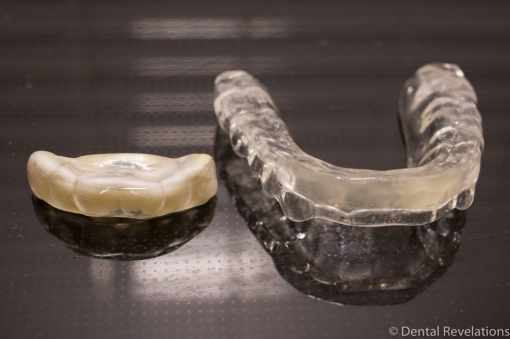
Now I tried to find you a web site that had a photo and impartial info about anterior night guard but wasn’t able to find one. So I took a photo of mine. I must apologise that the device is not in a mint condition anymore. There is my current mouth guard (that I will tell you more about later in this post) in the photo for comparison.
NTI/MCI/anterior night guard on the left
I felt this anterior night guard – I will call it MCI from now on – relieved the symptoms I had. I was very happy about the dentist and the MCI. Until I spoke to a former colleague of mine, a very good dentist.
He warned me that I was in risk of developing an anterior open bite due to a use of MCI. I did not second guess him once he explained the reasons.
With MCI the back teeth do not make contact. And when the teeth don’t make a contact with the opposite side they will erupt while the front teeth are kept in place by MCI. The over-erupted back teeth cause the open bite in the front. Simple as that.
We’ve all seen what happens to a tooth that lacks an opposing partner in occlusion. It over-erupts!
So I got an advice to use the MCI for 2 weeks and then keep 2 weeks break to avoid the over-erupting back teeth. So I did. But it did not keep the symptoms of grinding at bay.
My Third Mouth Guard Was Almost What It Should Be
Five years later I was back in my home country where I was advised to have a mouth guard done by a dentist in my practice. I did and she removed my upper wisdom teeth so that it was easier to have the mouth guard done. Once I received the mouth guard I didn’t feel it was helping me at all.
At this point I had had enough of the dentists in this matter and decided to see a specialist in prosthodontics. One that was known to be a good one.
The specialist did a careful examination on my teeth and the mouth guard. He said the mouth guard was ok’ish and that he just needed to adjust it. I also showed him my MCI which he advised to use only as emergency basis and only 4-5 days in a row.
I told to the specialist that I have a feeling that only my last molars were in contact. He checked it and said there was no imbalance – meaning that my bite was as it should be. I also asked if I should do the exercise for the jaw muscles. The specialist said there is no benefit of it.
I had to return to see the specialist every 6 months and every time he adjusted the mouth guard and charged quite a lot even compared to the specialist’s fares.
After 3 years of using the mouth guard there was a hole in it. I had apparently “bitten” through it. It was time to have a new mouthguard done.
My Fourth And Current Mouth Guard
For one reason or another I did not completely trust the specialist I had been seeing so I asked for recommendations of specialists from my colleagues. Based on the recommendations I went to see a specialist in prosthodontics and stomatognathic physiology – she had PhD too!
I was kinda shy when mentioning that I have a feeling that only my last molars were in contact – well hell yeah, one specialist had told me I was imagining things.
Only this time I was told I was right. She also told me that I have a partial anterior open bite. I was flabbergasted. I knew that not all the dentist master the matters of occlusion but even the specialists get it wrong!
And once she had done her magic about my occlusion by balancing it I felt the difference immediately.
By the way – my intact upper wisdom teeth were unnecessarily removed by the dentist who made my third mouth guard. A mouth guard can be done with the wisdom teeth in place as long as they are nicely positioned as mine were.
So after I had my occlusion sorted out I got my new bestest of the best mouth guard. It is amazing I must say. It brought me an immediate relief. But I was only half way through the treatment.
I was booked to see a dental hygienist who did massage for the muscles of the jaw in 3 separate visits and gave instructions (based on the specialist’s recommendations) on how to exercise the muscles by stretching and strengthening them. I realised that having a mouth guard is not enough. It won’t take away the root cause of the grinding which in my case was the weak muscles that did not support the jaw.
The MCI I was not allowed to use again. I did not argue with that.
Conclusion
I, a dental professional had three mouth guards (including the MCI) done until I got a proper one. None of the dentists I saw for the mouth guard had a clue about occlusion or what is the best treatment for it. The second specialist was only concentrating on the mouth guard and did not find the imbalance in my bite. Naughty naughty. I guess he was concentrating in money making – I sense these things as I am HSP – and that was probably one reason I didn’t go back to see him.
I worry over the patients who do not have an understanding of what is right treatment for grinding and clenching of the teeth. There are lots of people using MCI every night and they have been using it for years and years. Do they realise that the open bite they have developed is caused by the use of MCI? No they don’t as the dentist won’t necessarily tell them – especially if the patient is seeing the same dentist who recommended the MCI (see my previous post about this phenomenon). And it is not guaranteed that another dentist will tell either.
Also very commonly the treatment dentists offer for the grinding is the mouth guard. And only the mouth guard. But that is never enough! The best thing any dentist can do for the patient who is suffering from the grinding is to REFER to a specialist.
Important information for the patients: You can make a self referral to a specialist by simply booking an appointment. They will not say no to the new patients. Be prepared to pay more for the mouth guard but it is money well spent.
The occlusion is a delicate thing. I always advice patients not to let just anyone adjust the bite. It can go from bad to worse. You are in better hands when seeing a specialist in prosthodontics. The higher educated one the better – in any health matter.
I learned my lesson the hard way. I suffered from the grinding for many years. I lost two intact wisdom teeth unnecessarily. And I can’t help but think that the malocclusion on my back teeth and the partial anterior open bite were caused by the MCI. There was a dreadful moment when the specialist was thinking that I might need crowns for my intact canine teeth to fix the open bite and to get enough support for the side movements of the jaw. So I can count myself as lucky that the malocclusion could be fixed by simply filing the teeth.



 Dental Revelations