

New Natural Remedy (Fluoride-Free) for Decay

Dental Revelations

Just kidding. Just wanted to have your attention.

Today I am going to write about fluoride. And the reason for doing this is that I keep on running into articles and websites promoting fluoride-free toothpastes (and water). Not only they recommend non-fluoride toothpastes but also they tell that the fluoride is toxic or poison when entering body.

It is rather entertaining to read these articles but sooner or later the amusement turns into annoyance. Especially after comments like this

I love the look on dental hygienist’s faces when I refuse the fluoride treatments or toothpaste for me and my kids

When the adults practice their anti-fluoride beliefs on their kids it is simply heart breaking. I have seen kids whose milk teeth were so badly decayed that most of them had to be removed. I have seen kids in pain because of the decay.

Why would you want to put your kid through such experiences? They wouldn’t thank you if they knew what caused their bad teeth as an adult. But they will never find out the truth because they have been told that it runs in the family to have weak teeth… yeah right. There is no such thing as weak teeth that are hereditary. It’s all about oral hygiene habits and lifestyle habits.

What could be called hereditary is the bacteria in mouth that you might get from your parents as a baby. If the parents neglect their teeth (poor oral hygiene and lifestyle habits) there is great amount of cavity causing bacteria in the mouth and if that bacteria is transferred to the baby there are big chances the child will struggle with decaying. And this means this child needs fluoride. And if the parents do not offer it… pain, screaming in fear at the dentist, sedation/general anaesthesia, fillings, extractions, malposition of the permanent teeth because of the loss of the milk teeth… So unnecessary!

To be honest, I can understand the worry over the fluoridated water to some extent. After all it goes into your body.

But the fluoride toothpaste! You are not meant to swallow it, are you? With young kids you can’t prevent them swallowing the toothpaste but that’s why you use only very tiny amount of it.

But you adults, come on! The local effect of the fluoride is important in prevention of decay. You brush for 2 minutes (hopefully) and that’s the time the fluoride stays in your mouth. Then you spit it out and rinse with water (I don’t but that’s why I glow in the dark…ha-ha). No fluoride has entered your body.

20181104_152933.jpg

But still some people mix all sorts of things with “healing properties” to be used as a toothpaste. Herbs, clay, coconut oil etc. I just read an article about coconut oil that was recommended by Dr. Somebody to be used instead of fluoride toothpaste. And as if the article wasn’t full of baloney but the comments at the end of the article were even more so.

…I laugh when dentists tell their patients not to brush for an hour….. why leave the acidity on your teeth to do damage for an hour – five times a day – seven days a week etc…. it adds up!

This person refers to a previous comment where somebody said he vigorously rinses his mouth with water after eating anything (which is fine). I’m sure all the professionals know what will happen to the teeth if one brushes every day after every meal – five times a day – seven days a week etc.

Erosion or to be precise it is abrasion that will happen to the teeth and that is irreversible damage which will lead to hypersensitivity of the teeth and make the teeth more prone to decaying.

Facts Simplified

There are minerals in the enamel of the tooth (hydroxyapatite). Minerals like calcium are lost everyday from the enamel because of the acids the bacteria produce from the carbohydrates in the diet.

The saliva tries to minimise the loss of minerals by neutralising the acids (remineralisation) but saliva can’t do magic if the host’s lifestyle is giving it too much to handle. Snacking (eating more frequently than 5-6 times a day), drinking acidic or sugary drinks in daily basis between the meals, eating sweets the wrong way (yes, there is a right way of eating them), adding sugar to the tea/coffee (even milk contains sugar) and consuming them between the meals. All these habits produce too much acid for the saliva to handle and it is not able to return all the lost minerals back to the enamel.

Loosing too much minerals from the enamel means decaying.

So to prevent that you need to find a way to compensate the lost minerals. The most important one is the calcium. And when combined with fluoride it repairs the enamel with very strong fluorapatite that is hard for the acids to break. It is much stronger material than hydroxyapatite that the enamel is originally made of. Some professionals even say that area of the enamel that has been replaced by fluorapatite won’t ever get decay.

But even if you do use fluoride in some form you will get decay if you have poor oral hygiene and your eating habits are harmful to the teeth. The fluoride will only slow down the decaying process.

There are exceptions of course. There are individuals who neglect their teeth and never get a decay. They might not use fluoride toothpaste or they might not brush at all. I will emphasise that they are exceptions. Average Joe will get decay I’m afraid. I have already written about this on my previous post. I wrote that it is very rare for people to have good enough oral hygiene habits. It is about one in thousand patients who do not need my interference in looking after their teeth. So most of us need minerals (calcium and fluoride) to protect the teeth from our laziness and unhealthy lifestyle.

Fluoride we cannot get through our diet unless you eat fish with the bones but even then there is no localised effect on teeth. So we need it from somewhere else. And the fluoridated water is simply not enough as it passes through the mouth and does not provide long enough localised effect (so don’t use that as an excuse). That’s why we use the toothpaste.

Right Way of Eating Sweets (Thought You Might Want to Know)

You can eat sweets without getting decay. Us dental professionals are a living proof of that. You see we looooove to eat sweets but rarely get decay. I will tell you how we do it.

  1. If you buy pack of sweets eat them in one go and have xylitol chewing gum, slice of cheese or fluoride tablet once you are finished. If you eat one sweet every 10 minutes for the next two hours you will have an acid attack in you mouth for approx. 2 hours and 30 minutes. Or even worse example. If you take one sweet every 30 minutes for the full working day it means you have had an acid attack the whole time you were working. Acid attack means losing minerals. And I have already told you earlier what happens if you loose too much minerals which you certainly will do if you have 7-8 hour-long constant acid attack.
  2. Eat sweets as dessert. You get acid attack already because of eating and you can avoid getting an extra acid attack by eating the sweet in one go after a meal. Have xylitol chewing gum or pastille, slice of cheese or fluoride tablet once you are finished.dental-revelations-blog2
  3. Whenever possible and if you stomach can take it, buy sweets that are sweetened by xylitol. Now people often blame the xylitol for the laxative effect of sugar-free sweets. But it is often not the xylitol that causes the upset stomach. It is the maltitol syrup. So seek products that are sweetened 100% by xylitol.


Please note: This post is directed to healthy adults. People whose saliva flow is impaired through illness or medication need more intensive fluoride treatment on their teeth.
Hands up Who Knew That Zinc in Toothpaste Can Cause Dry Mouth?

Dental Revelations Blog-4039

I have noticed it is very easy for a health care professional to get annoyed about different things by just browsing through dental forums and discussion sections of dental news.

This time it was the toothpaste.

Especially the toothpastes of certain big brand that promise all sorts of things but have side effects the representatives sweep under the carpet by saying casually

It’s perfectly safe to use

It’s normal

Yeah, peeling off the mucosa in your mouth is normal. I wouldn’t be so sure. Especially with the patients who have a sensitive mouth.

The salesmen of the manufacturers of oral hygiene products would sell their granny to promote their products. They can tell a fib or even lie to your face without loosing a good night’s sleep. All they want to achieve is that you will start to recommend their products. This is enhanced by giving the practices boxes and boxes of free samples which I have written about in my previous post Can you trust the recommendations given to you by a dental professional?

Are We Fooled by the Representatives and Adverts?

I remember an occasion when a representative of this big company came to my practice to introduce new products. These new all-in-one toothpastes. There were many different toothpastes in the same product family. One for everyone even though the first all-in-one toothpaste introduced not so long before these new ones was supposed to be the one to deal with e-v-e-r-y problem one could have. Slightly confusing I think.

Anyway, the rep went through these new toothpastes and recommended the sensitive version also for the sufferers of dry mouth. Then on the next sentence she mentioned that this sensitive toothpaste contains zinc…

Rather boring session got my interest immediately. Dry mouth and zinc? You got to be kidding me?

We dental professionals know our business. Every detail of it. Well at least I hope most of us do. Despite this I have noticed that many dental professionals are fooled by these selling speeches representatives give and do not notice that the things coming out of their mouths are simply bogus.

So I looked around to see if anyone else was looking puzzled? If anyone was about to say something? No, not a chance. They were just leaning back on their chairs with empty eyes staring at the products. But I couldn’t keep quiet. I never really have learned to keep my thoughts to myself especially if somebody is talking nonsense.

So I raised my hand to get a say (and I swear I could see my colleague roll her eyes meaning here we go again). The rep looked surprised.

Me: Did you say this toothpaste is for people with dry mouth?
Rep: Yes I did.
Me: And it has zinc in it?
Rep: Yes it has.
Me: But the zinc associated with dry mouth, isn’t it? It can make the dry mouth worse.
Rep: Err, I must say I do not have an answer for you now. But let me get back to you on that. What’s your e-mail address? I’ll find out and send you an e-mail as soon as possible.

A typical diversion from the subject. About month later I received an e-mail which said:

Hello,

I remember you asked something about the sensitive toothpaste. Care to clarify what was you specific question? All the toothpastes are well researched and tested. They are widely recommended by the dentists. Bla-bla-bla…

Yours truly,

Representative-that-will-not-come-to-my-practice-again-if-it’s-up-to-me.

Knowing Your Business in Depth

Now I must tell you that I did not know that zinc in toothpaste can be a culprit to dry mouth until another rep of another big oral hygiene product manufacturer (wouldn’t it be easier if I just told you which company?!) told me so couple of years ago.

I had recently tested their toothpaste for halitosis and got extremely dry mouth (honestly, I thought I will die of thirst between brushing my teeth and reaching the office in the morning). When I asked the rep about it she said that it could be due to the zinc in the toothpaste and asked me to file an adverse event report. She even gave me the document to fill in.

I was impressed. Not about the Sahara-Desert-in-mouth toothpaste but about the honest rep who could tell me something I didn’t know.

Since then it’s not been just once or twice that I have found out that my patient who is suffering from a dry mouth is using a toothpaste containing zinc.

The dentistry is constantly evolving. It is hard to keep up to it but we must. It is the only way we can give the correct advice to the patients.

Conclusion

It just occurred to me that I might be taking the visits of the representatives of oral hygiene products the wrong way. Perhaps it is accustomed way to let the reps babble away without questioning what they are saying. Am I considered to be rude to interrupt them when they are just trying to do their job? Should I just sit in silence when they are clearly not on the right path?

Perhaps, but I’m afraid it won’t happen in the near future. Or never. You see, isn’t it so that the annoying sides of one’s personality is only enhanced when one gets older?

Anyway. Be cautious of the advertising speeches of the reps. Read scientific studies about the ingredients and then make up your own mind if you will recommend certain products. Try them yourself and pay attention to how your mouth responds.

My advice for the patients is to use a toothpaste that feels good in their mouth. If the toothpaste burns, stings, makes your mouth numb or if you experience any other uncomfortable feeling STOP USING IT.


You might also like

Oral-B Gum & Enamel Repair Original Toothpaste Review

RDA Value in Toothpastes – Any Relevance?


Why People Hate Teeth Cleaning at the Dentist

Dental Revelations Blog-3916
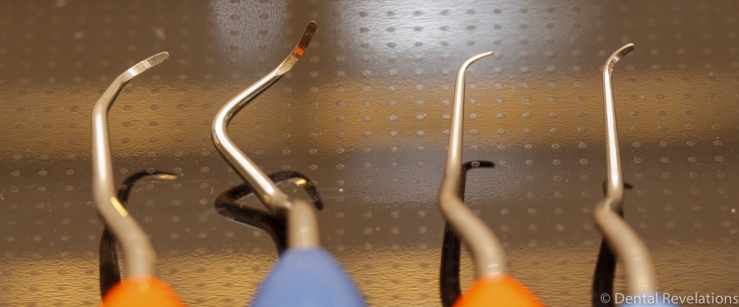
We do the teeth cleaning with these “hooks”. We like to call them curettes.

The most common things patients say to me when they enter my practice for teeth cleaning are

I hate this

It hurt a lot last time

Are you going to use the hooks??

But once we are done with the treatment they are visibly relieved, thank me for being gentle and share their story about the previous dentist/hygienist who did the scaling. The stories are horrendous and it often makes me feel ashamed of my colleagues. Why are they failing in very simple task – managing the pain?

For those who now think that I must not do the scaling very well if it doesn’t hurt:

Me being gentle does not equal me being less thorough with the scaling. I go to those 12 mm deep pockets with my hand scalers and sometimes even without any local anaesthesia. I remove all the subgingival calculus that is possible without surgery – if not on the first visit then on the following visits. And yet the patient thank me for being gentle.

How is this possible? Let me tell you how. If you are a patient, there is information for you at the end of this post.

Butchers

When I was at dental school I worked as a nurse in private practices (I have written about this period in my life in my previous post). I was a nurse for a young dentist who was performing a scaling for the patient. It was the most unpleasant piece of treatment I have ever witnessed. It was a bloodshed. A complete massacre of the gums.

The patient did not have severe gum disease – just gingivitis. The dentist did not use local anaesthesia and took her sickle and started the scaling (or her interpretation of it). Pieces of interdental papilla were flying around and the mouth was filling up with the blood… I am slightly exaggerating of course, but just slightly.

The patient was wriggling but did the dentist offer local anesthesia? No she didn’t. She carried on with the massacre. All I could do was to place my hand gently on patient’s shoulder as way of comfort in this horrible experience that should never had happened.

In the end of the treatment she had removed all the interdental papillae from patients mouth. Instead of the interdental papillae there were now dark red blood clots. Hands up everyone who knows this should not be done! I hope there are some of you.

Now this was my experience that I witnessed. The rest my patients have told me. The stories do not vary a lot from what you just read.

The Pain Threshold

All the patients are different when it comes to the pain threshold. Some people cannot take any pain and require topical anaesthesia even for probing. Some go through the whole scaling without any complaints and do not want to have a local anaesthesia even when suggested.

But the most important thing with every patient is to tell them about the options for pain relief.

When I see a patient for the first time they are often very sceptical and think they need all the possible pain relief there is. In these cases I suggest that we first try without and if the pain relief is needed it can be applied any time.

The reason I do this is that I have noticed that the fear of the pain is sometimes greater than the actual pain. Once the patients realise this they relax.

Doing It in One Go

This is not how you should do it.

When the gums are inflamed they hurt. As a patient you do not want anyone you just met digging your tender gums with a sharp instrument.

So on the first visit it is important to teach the patient better oral hygiene routines and techniques and get rid of the supragingival calculus (visible calculus) and some of the subgingival (invisible) as well (as much as the patient can take the discomfort).

I rarely use hand instruments on the first visit. I concentrate on very thorough scaling with the sonic scaler (EMS is my favourite). I might still use Mini and Micro Sickle for the lower front area as there is often calculus and stains left after the sonic scaler. Plus the patients loooove to get shiny white smile on the first visit.

Remember to tell the patient that there is (invisible) calculus still to be removed as they might not return for the following visits when the bleeding of the gums stops. It is important to mention that if the calculus is not removed it can result in periodontal abscess and bone loss. Eventually the gums will start bleeding again.

After this I let the gums heal at least for a week. It is much easier for the patient and for me to perform the subgingival scaling when the gums have healed and shrunk. Sometimes they have shrunk that much that not much of the calculus is hidden below the gum line – but this requires the patient to do his share with the oral hygiene at home.

Technique of Scaling

This is where most of the “butchers” fail. They either use wrong tools or right tools but wrong technique.

When I began working in my first surgery abroad and saw the scalers I was supposed to use I declined kindly and persuaded the owner to order me the instruments I preferred. It was a difficult task as the hygienists had used those “instruments for giants” without complaints. I explained that the curettes were far too big for anyone’s teeth. They were clumsy and big and the metal was very “stiff”. Luckily the owner was a wise dentist and I was allowed to order new ones.

The scalers I have by default for all the patients are:

Micro-Sickle by LM

Mini-Sickle by LM

Mini-Syntette by LM

With these I can do simple scale and polish but if there are pockets deeper than 3mm I have curettes at hand in a sterile pouch and I choose them by the location and the shape of the pocket. I have sets of curettes in pouches as listed below:

Mini-Gracey 11/12 by LM

Mini-Gracey 13/14 by LM

Gracey 11/12 by LM

Gracey 13/14 by LM

and

Mini-Gracey 17/18 by LM

and

Gracey 17/18 by LM

and

Furkator KS by LM

Please note that I do not get any financial benefit of writing about certain brand of instruments.

Chlorhexidine After Scaling

I always rinse the deep pockets with syringe filled with 0,12% chlorhexidine liquid or gel. It reduces the risk of complications.

Sharpening

Blunt instrument results in slipping of the instrument either to the patients gum or your finger. Neither is good. Blunt instrument also does not remove the calculus – it only polishes it.

It is very important to sharpen the curettes after each use (sickles and syntette do not require sharpening that often). It doesn’t matter if you do it by hand or by sharpening machine. Both of them require skill but the only difference between these two is that the hand sharpening extends the life expectancy of the curette.

I sharpen my instruments in a cycle of hand sharpening two to three times in a row and then machine sharpening once. I sharpen once a week all the instruments that have built up in a week. For you being able to do this you need at least a week’s worth of instruments in the surgery.

Tip: When you sharpen your instruments always check with a test stick first if the instrument is in fact sharp enough. Sometimes if you have used the instrument only for couple of strokes it remains sharp.

Informing the Patient About the Post-Scaling Complications

There will be tender gums after any scaling and polishing. But the patients can take it much better when they are informed about the different kinds of complications that might occur and how they can manage them.

The most common complications and ways of relieving them are:

  • tender gums – cold drinks/food, paracetamol/ibuprofen, never aspirin as it might make the gums continue bleeding
  • taste of blood in the mouth – normally it is resolved by the next day
  • sensitivity to cold – sensitive toothpaste, leaving the toothpaste in mouth after brushing, avoiding acidic food/beverages

It is also good idea to mention the less common complications and the ways of relieving them:

  • extreme pain in the gum caused by secondary infection that lasts for many days – salt water rinse, chlorhexidine rinse (alcohol free) or to see your dentist if the symptoms persist
  • pain around the partly erupted wisdom teeth – chlorhexidine rinse or to see your dentist if the symptoms get worse despite the rinsing
  • periodontal abscess – to see the dentist

If the patient is left untold about these complications and if they do happen it is very likely that the patient blames you. And he will tell this to ten of his mates (marketing rule) even though there was nothing wrong with your scaling skills.

But when explained that you have now disturbed the bacteria balance in the deep pockets by scaling and even though it was necessary and important thing to do the bacteria in the pockets sometimes – in rare cases – do not like it and the situation might get worse, you will have much more satisfied patient even if complications occur. A patient that still trusts you.

Conclusion

Having the teeth cleaned at the dentist should not be painful. Some discomfort is acceptable but it should always match to the patient’s individual pain threshold. And after the scaling the patient’s gums should not look as if Jack the Ripper had done the treatment.

The right technique of the scaling is difficult to master. But once you do, it will be more rewarding for you as you see better healing results with the gums and a happier patient. Here’s one video about hand scaling technique (it’s not ideal video but hopefully you get the idea) but I’m sure hands on courses are available at the dental schools as well.

For the hygienist – please do not accept just any hand scalers. Check out different brands of curettes at the dental show case and order couple of them to try out. If you are unsure with your technique start with the mini-curettes.

For the patient – If you’ve had bad experience at the dentist with the cleaning of the teeth seek another one. Change until you get proper cleaning, relevant info and oral hygiene instructions. Be prepared to have at least two visits.

When you maintain good oral hygiene habits and see your hygienist for regular teeth cleanings (interval decided individually, see my previous post) you will never ever need to go through the same experience again. It takes just one visit to clean your teeth and it is much less painful.

If you do not do your part at home and leave longer period of time than recommended between the cleanings it often takes two visits to do it. And once again it is unpleasant for you.

I worry over the fact that the patient is unable to tell if the scaling was done thoroughly. I have written about this before. It is not until the patient by chance sees somebody who recognises the gum disease and masters the comprehensive treatment for it, when they realise the poor quality of the treatment they were getting in the previous practice.

That, my dear readers simply is not acceptable in the modern dentistry. So revise, revise and revise. Trust the patient’s reaction. If they complain often that it was a horrible experience then something is wrong with your scaling technique, your tools or your chair side manner. Swallow your pride and do something about it.