
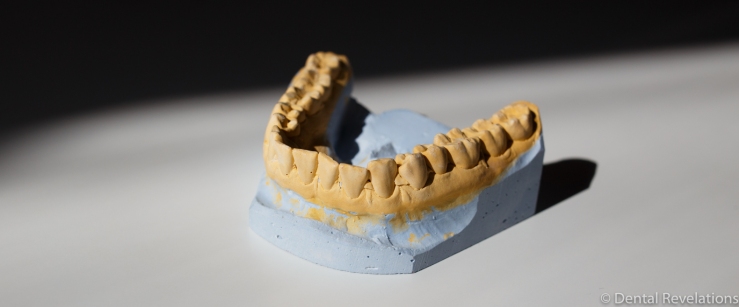
Don’t Let Just Anyone Touch Your Occlusion

Dental Revelations Blog-3878

Grinding or clenching of the teeth is a very common problem. It is a nasty problem for its bearer as it causes pain in the muscles and in the jaw joint, headache, toothache and even disturbed sleep at night. If nothing is done to the problem the teeth will eventually suffer from the grinding especially if the occlusion is imbalanced. There will be a recession in the gum, worn enamel, chipped enamel and periodontal problems to start with.

So if you do know that you grind or clench your teeth at night – or even more so if you clench your teeth during the day which is a definite sign that you do it also at night – go to see your dentist. But here’s an important advice:

Do not go to see just any dentist. Find a specialist in that has done 3 extra years of stuyding to gain the title prosthodontics (even better if one has a PhD).

Why? I will tell you the reasons from my own experience.

My First Mouth Guard Or Should I Say Bite Block

I am a dental professional and in my early career I was quite naive and thought that all the dentist can do all the stuff they are taught at school. I was so wrong.

In my first year after graduation I had a bite guard made by a regular dentist in my practice. I soon realised it wasn’t perfect and sought help from a specialist in prosthodontics who was working in our practice.

The first thing the specialist did was that he filed away about 0,7 cm (0,28 inches) of the hight of the bite guard without fitting it in the middle of the filing. Once he was done with the filing he started to adjust it to my occlusion. He was covered with acrylic dust and he did lots of eye rolling and head shaking.

He told me that the bite guard is not ideal and it would be better to have it redone. I never really used it after that and I carried on suffering from the grinding and clenching of the teeth.

My Second Mouth Guard – When Desperate You Accept Anything

Couple of years later I lived in another country and once again sought help from a dentist for the grinding. She recommended me an anterior night guard (also known as NTI or MCI) which she did routinely for every patient suffering from grinding.

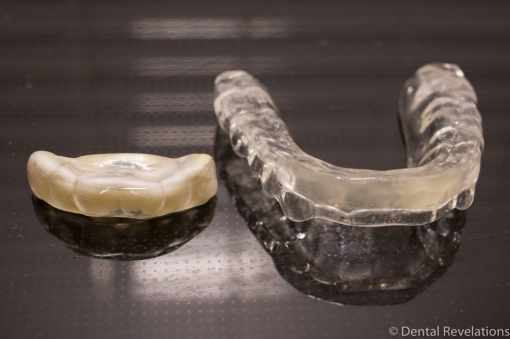
Now I tried to find you a web site that had a photo and impartial info about anterior night guard but wasn’t able to find one. So I took a photo of mine. I must apologise that the device is not in a mint condition anymore. There is my current mouth guard (that I will tell you more about later in this post) in the photo for comparison.
Dental Revelations Blog-2
NTI/MCI/anterior night guard on the left

I felt this anterior night guard – I will call it MCI from now on – relieved the symptoms I had. I was very happy about the dentist and the MCI. Until I spoke to a former colleague of mine, a very good dentist.

He warned me that I was in risk of developing an anterior open bite due to a use of MCI. I did not second guess him once he explained the reasons.

With MCI the back teeth do not make contact. And when the teeth don’t make a contact with the opposite side they will erupt while the front teeth are kept in place by MCI. The over-erupted back teeth cause the open bite in the front. Simple as that.

We’ve all seen what happens to a tooth that lacks an opposing partner in occlusion. It over-erupts!

So I got an advice to use the MCI for 2 weeks and then keep 2 weeks break to avoid the over-erupting back teeth. So I did. But it did not keep the symptoms of grinding at bay.

My Third Mouth Guard Was Almost What It Should Be

Five years later I was back in my home country where I was advised to have a mouth guard done by a dentist in my practice. I did and she removed my upper wisdom teeth so that it was easier to have the mouth guard done. Once I received the mouth guard I didn’t feel it was helping me at all.

At this point I had had enough of the dentists in this matter and decided to see a specialist in prosthodontics. One that was known to be a good one.

The specialist did a careful examination on my teeth and the mouth guard. He said the mouth guard was ok’ish and that he just needed to adjust it. I also showed him my MCI which he advised to use only as emergency basis and only 4-5 days in a row.

I told to the specialist that I have a feeling that only my last molars were in contact. He checked it and said there was no imbalance – meaning that my bite was as it should be. I also asked if I should do the exercise for the jaw muscles. The specialist said there is no benefit of it.

I had to return to see the specialist every 6 months and every time he adjusted the mouth guard and charged quite a lot even compared to the specialist’s fares.

After 3 years of using the mouth guard there was a hole in it. I had apparently “bitten” through it. It was time to have a new mouthguard done.

My Fourth And Current Mouth Guard

For one reason or another I did not completely trust the specialist I had been seeing so I asked for recommendations of specialists from my colleagues. Based on the recommendations I went to see a specialist in prosthodontics and stomatognathic physiology – she had PhD too!

I was kinda shy when mentioning that I have a feeling that only my last molars were in contact – well hell yeah, one specialist had told me I was imagining things.

Only this time I was told I was right. She also told me that I have a partial anterior open bite. I was flabbergasted. I knew that not all the dentist master the matters of occlusion but even the specialists get it wrong!

And once she had done her magic about my occlusion by balancing it I felt the difference immediately.

By the way – my intact upper wisdom teeth were unnecessarily removed by the dentist who made my third mouth guard. A mouth guard can be done with the wisdom teeth in place as long as they are nicely positioned as mine were.

So after I had my occlusion sorted out I got my new bestest of the best mouth guard. It is amazing I must say. It brought me an immediate relief. But I was only half way through the treatment.

I was booked to see a dental hygienist who did massage for the muscles of the jaw in 3 separate visits and gave instructions (based on the specialist’s recommendations) on how to exercise the muscles by stretching and strengthening them. I realised that having a mouth guard is not enough. It won’t take away the root cause of the grinding which in my case was the weak muscles that did not support the jaw.

The MCI I was not allowed to use again. I did not argue with that.

Conclusion

I, a dental professional had three mouth guards (including the MCI) done until I got a proper one. None of the dentists I saw for the mouth guard had a clue about occlusion or what is the best treatment for it. The second specialist was only concentrating on the mouth guard and did not find the imbalance in my bite. Naughty naughty. I guess he was concentrating in money making – I sense these things as I am HSP – and that was probably one reason I didn’t go back to see him.

I worry over the patients who do not have an understanding of what is right treatment for grinding and clenching of the teeth. There are lots of people using MCI every night and they have been using it for years and years. Do they realise that the open bite they have developed is caused by the use of MCI? No they don’t as the dentist won’t necessarily tell them – especially if the patient is seeing the same dentist who recommended the MCI (see my previous post about this phenomenon). And it is not guaranteed that another dentist will tell either.

Also very commonly the treatment dentists offer for the grinding is the mouth guard. And only the mouth guard. But that is never enough! The best thing any dentist can do for the patient who is suffering from the grinding is to REFER to a specialist.

Important information for the patients: You can make a self referral to a specialist by simply booking an appointment. They will not say no to the new patients. Be prepared to pay more for the mouth guard but it is money well spent.

The occlusion is a delicate thing. I always advice patients not to let just anyone adjust the bite. It can go from bad to worse. You are in better hands when seeing a specialist in prosthodontics. The higher educated one the better – in any health matter.

I learned my lesson the hard way. I suffered from the grinding for many years. I lost two intact wisdom teeth unnecessarily. And I can’t help but think that the malocclusion on my back teeth and the partial anterior open bite were caused by the MCI. There was a dreadful moment when the specialist was thinking that I might need crowns for my intact canine teeth to fix the open bite and to get enough support for the side movements of the jaw. So I can count myself as lucky that the malocclusion could be fixed by simply filing the teeth.

Phew!


You might also like

Eeny Meeny Miny Moe – Which Type of Tooth Wear?


How Clean Are Your Hands?

Dental Revelations Blog-2

I used to work with a very talented oral and maxillofacial surgeon who did not accept just any nurse to be his assistant. The reason for this was that he wanted absolute aseptic environment for the implant surgeries he was performing. In his words

“One either has an aseptic consciousness or doesn’t. It cannot be taught.”

At that time I thought he was exaggerating but I have learned since that he was actually right.

Simplified, the aseptic conscious is an ability to know when surface, instrument, hand is contaminated by bacteria and how and in which order you start to fix it to make it asepsis. It is an ability to know where you can touch without contaminating the gloves when you are treating a patient. It is the key for effective cross infection control in dental practices.

We learn asepsis at dental schools. But there are things you cannot learn by just reading from the book. Sometimes even practice won’t teach us. In my experience aseptic conscious is as hard to learn as singing. If you do not have the gift you will not become a successful singer (the one’s singing in the shower do not count in this comparison!).

Failing in Basics

A dentist puts her face mask on, washes her hands and puts the gloves on. She gets closer to the patient, adjusts her face mask and uses her little finger to move her hanging fringe to the side of her head…

Err, what went wrong? Pretty much everything after putting the gloves on.

Not understanding what contaminates the clean areas/instruments/hands is a major problem in dentistry. It applies to all the dental professionals – not only the dentists. Even bigger problem is that it is also a subject amongst dental professionals that is hard to bring up if you see a colleague doing something that compromises the cross infection control.

But we must speak about it! How else would they learn asepsis?

Clean Hands

Washing hands needs to be done correctly for it to be effective. But washing hands can be replaced by the use of disinfection gel if the hands are not visibly contaminated. But this needs a correct technique too.

All the professional’s should watch this video about washing hands and using the disinfection gel. I bet many of us fail in the technique.

I must point out that in this video they apply far to little of disinfection gel – if you have an automatic dispenser like the ones the hospitals have, trust the amount the dispenser gives you even if it feels too much.

Also in this video they begin the use of disinfection gel in wrong order. The correct technique goes like this:

  1. Take the gel to the palm of your left hand (or the right, it doesn’t matter from which hand you start)
  2. Dip the finger tips of your right hand in the gel on your balm
  3. Pour the gel to the palm of the right hand
  4. Dip the left hand’s finger tips in the gel
  5. Only then start to spread the gel as advised in the video

Important to remember: Never try to speed up the evaporation of the disinfection gel by waving your hands in the air. This will only contaminate your hands with airborne pathogens.

Revelations

Too many of us professionals fail in either disinfecting the hands or keeping them uncontaminated during the treatments. To prove my point I will tell you my observations.

I have seen

  • dentist removing temporarily his face mask during the treatment to speak to the patient and placing it back again (the same mask and the same gloves) before continuing the treatment
  • dentist using the mirror handle’s tip to press computer keyboard key’s in the middle of the treatment
  • dentist touching the water tap (especially when adjusting dentures/bite block to rinse the apparatus) with the gloves he’s entering patient’s mouth
  • dentists, hygienists and nurses to reach instruments/materials inside the surgery cupboard with gloves that are contaminated by patient’s saliva
  • dentists removing their glove from one hand in the middle of the treatment to do something “aseptically” and then placing the same glove back again
  • dentists removing both of their gloves in the middle of the treatment to do something “aseptically” and then placing the same gloves back again
  • dentists using disinfection gel for the gloves
  • nurses having long and polished nails – I mean reeeally long
  • dentists, hygienists, nurses wearing watches and bracelets

Thank god dental surgeries are pretty much paperless nowadays. The dentists used to check the dental records in the middle of the treatment with the same gloves as they were treating the patient.

Conclusion

A Dentist, hygienist or nurse with pathogen-free hands is every patient’s right to have.

So do pay attention how you get ready for the treatment with each patient. Sometimes we are behind schedule and we cut corners but with this matter you simply cannot.

I will end this post by an information on how all the dental professionals should get ready for the patient (in every day dentistry) and hope you will follow this advise already today.

Before the treatment:

  1. disinfection gel (or hand wash if visibly contaminated hands)
  2. face mask and eye protection
  3. disinfection gel
  4. gloves

After the treatment:

  1. Remove the gloves
  2. disinfection gel
  3. remove the face mask and eye protection
  4. disinfection gel

You might also like

It’s ok to swallow, it’s only water… Or is it?

Are Your Dentist’s Tools Clean?

Dentists! It Is Time to Raise Stakes with Coronavirus

Wild West of the Home Whitening

Dental Revelations Blog-0310

Oh dear, where to begin.

The reason I chose this topic for my next post is that I was reading a dental blog that gave homemade teeth whitening tips to people. I’m sure the intention was good when they listed all known household items than can whiten the teeth. You see people love to get self-help tips on their health – especially on their teeth to avoid seeing the dentist. But dental professionals should know better not to advice certain things as they can very quickly cause permanent damage to the teeth.

(This is a reminder for all of us not to believe everything you read from the net especially regarding your health)

Stains

There are two types of stains on your teeth. Surface stains and deep stains.

Surface stains build up from coffee, tea, red wine, smoking and certain spices, mouthwashes and vitamin supplements (iron in a liquid form).

Deep stains are those that will make the natural colour of your teeth (which you will see after scale and polish when the surface stains have been removed) yellower. The older you get the yellower the teeth will get (or have you seen elderly people with pearly white teeth? If you have they are false).

So what will damage your teeth? I will tell you. Starting from the worst. But at first for clarification

  • I will not give any instructions on how to use these substances
  • it won’t be a comprehensive list of the substances that is advised to use for teeth whitening purposes but a list of most common ones

Whitening Toothpaste

There are normally two types of whitening toothpastes. Toothpastes with increased abrasivity (normally all most common brands’ whitening toothpastes e.g. Crest, Golgate, Arm&Hammer) have high RDA level (higher than RDA 100) and if used regularly, it can lead to toothwear. This toothwear is permanent. I never advice anyone to use these toothpastes on regular basis.

Safer types of whitening toothpastes are the ones that do not have high RDA level but are based on papain enzyme which whitens the teeth. Examples of these toothpastes are brand Youtuel (RDA 40) and Glodent. When I used Youtuel for the first time somewhat 20 years ago, it was impressive how well it removed surface stains.

If you are interested to read a study about papain enzyme as whitening ingredient, click here.

Lemon

Would you love to get white teeth with practically no money spent at all (as you get the lemons anyway for cooking etc) plus super sensitive teeth and eroded enamel to go with the deal? Yes? Use lemon.

An advice to use lemon for teeth whitening isn’t under any circumstance acceptable by a dental professional. Lemon is highly acidic fruit and can erode the teeth when used regularly. Erosion will result in sensitive teeth. Imagine if you already have thinned enamel for any reason and you start to use lemon for whitening purposes. You will soon find out it wasn’t a wise move as your teeth will become so sensitive to the cold that even breathing through your mouth hurts. Also the thin enamel will make you more prone to decay.

In 2005 BBC had to apologise publicly for a lemon tooth whitening tip when one of its programmes recommended lemon as a money saver to families. I happened to watch this programme and couldn’t believe what I was seeing. Thank goodness British Dental Health Foundation soon found out about the programme as well and complained to the BBC.

I’m not convinced that the apology reached everyone who watched the programme.

Strawberry and Baking Soda

Now combination of these two used daily for longer period of time will damage your enamel. Baking soda works as abrasive and strawberry as an acid. A very bad combination.

Safe frequency of use is once a week.

Baking Soda

It is slightly abrasive to teeth and can damage the teeth especially if used with vigorous brushing technique.

Do not use baking soda if you have braces. It can soften the glue.

Salt

Salt crystals can scratch the enamel. Make sure to let the salt dissolve in the water before using it (kinda looses the point of using it, doesn’t it?).

Hydrogen Peroxide

Hydrogen Peroxide is the only known substance that removes deep stains. It doesn’t remove the surface stains so scaling and polishing is normally needed prior the whitening.

There are products over the counter (OTC) that contains hydrogen peroxide but these should be used under a supervision of a dentist as the excessive use of hydrogen peroxide will weaken the enamel permanently.

After Words

If you cause damage to your enamel by these abrasive or acidic home whitening products, it will be permanent. Thin enamel not only make the teeth sensitive to cold and prone to decay but it also makes the teeth look darker or yellower in colour. The dentin under the enamel is more yellow than the enamel and it will start to show through when the enamel gets thinner.

Important facts to remember

  • you can never ever change the natural colour of your tooth by lemon, baking soda, strawberry, whitening toothpastes etc. You may be able to remove the stains from the surface of the tooth but not the actual colour that is different with every individual
  • you should never replace fluoride toothpaste with any of the above means. Thinning of the enamel together with lack of fluoride will speed up sensitivity and decaying
  • all the means of whitening the teeth will result in damage of the enamel at certain level
  • any of the whitening products do not whiten fillings or crowns
  • the surface stains will carry on building up after the whitening if you carry on smoking and drinking coffee/tea/red wine. Also the new whitened natural colour of your teeth (whitened by hydrogen peroxide) will little by little get more yellow for the same lifestyle reasons

An impartial information about the risks of teeth whitening is almost impossible to find. The internet is full of practices advertising themselves and saying it’s all fine and dandy to do the whitening. So be cautious!

If you are interested in reading reliable article click here.