Ever Seen a Patient with an Implant? Read This!

Dental Revelations Blog-4621

Today I saw a patient who had had an implant done to replace upper right first molar. The implant treatment was finished a year ago in another practice.

Since then the patient had seen hygienist twice in my practice. The implant crown itself looked immaculate but the gum was very red and puffy and it bled heavily after probing.

I knew what to ask next and I even knew the patient’s reply to this.

“Were you told how to clean the implant at home?”

“No I wasn’t” replied the patient with is-it-supposed-to-be-cleaned-expression on his face.

This happens too often. Almost every time I see a patient who has recently had an implant done.

Note for all the dental professionals who make the implant treatment’s final stages and do not give oral hygiene instructions (OHI) for the patient:

You should always tell and show how the patient can clean these costly pieces of metal and porcelain. It is your responsibility as a dental professional and the paying patient’s right!

Can you give me any other excuse for not giving OHI than the fact that you are too busy making money and forgetting the basics? I believe you cannot.

And you hygienists who see patients with implants:

  1. Always check how the patient is cleaning them. More so if the gum around the implant is either bleeding or there is plaque around it
  2. Advice if necessary and show in their mouth how it is done
  3. Check if the patient understood your instructions by asking them to show they can do it. Teach them if they struggle
  4. Check on a follow-up visit that the gum has healed. If not, refer to a dentist

Why Is It So Important?

With the implants it is vital that there is no bleeding in the surrounding gum. They will get an implant’s equivalent to gingivitis – peri-implant mucositis which can lead to the peri-implantitis (same as periodontitis with teeth) very rapidly. The worst case scenario is that the implant will lose its integration to the bone which could have been easily prevented.

The patient I saw today left home with instructions on how to look after his implant. And I will see him for a follow-up visit to make sure the gum has healed (can you see the shining halo around my head?).

Honestly, it’s not that hard to do your job properly so shape up please!


Here‘s further reading on the subject.

Part I: Is It a Skyskraper? No, It’s Your Ego

Dentalrevelations

On my second post I promised to write about personalities of the staff in dental practices and how they may affect the dental practice and the treatment given to the patient. I’m going to fulfil this promise today. And on my next post. And the next.

I am going to write a series of posts about this topic. Each post will have a viewpoint of one dental professional. Today it will be the hygienist’s.

I’m Not Going to Play with You

As long as there have been dental hygienists there have been dentists who are afraid of losing their living because of them. These dentists either refer only the simple scale and polish to the hygienist or do not refer at all.

They treat the patients with advanced gum disease themselves as it requires more visits. More visits equals more money per patient. And the money is the only motive they have for this silly way of practicing the dentistry.

The problem with these kinds of dentists is that most often the hygienist would have better skills to treat the advanced gum disease than the dentist and this is revealed when the patient sees the hygienist six months later. Often there is subgingival (invisible) calculus still left even though it should have been removed on the first course of treatment. Plus the patient has no clue how to clean her teeth effectively.

Big Ego

It is a fact that the oral and maxillofacial surgeons have a big ego. Or to precise – they have a huge ego. But in my opinion they have all the right to have one. They NEED one to be able to perform all the talent requiring hocus pocus on patients mouth, jaw and face. Plus they don’t use their ego against co-workers or the patients.

But when a dentist has a big ego it rarely is attractive or talent enhancing. I will give you an example from a real life.

A dentist does a check-up for a patient. Then the patient sees a hygienist for a scale and polish. Whilst scaling with curettes the hygienist notices there are potential cavities in three different sites and she checks the patient’s x-rays. The x-rays confirm the suspicion.

The hygienist checks the dentist’s notes for the check-up visit to see if there is a treatment plan to fix these cavities. There isn’t. It appears as if the dentist has missed the cavities when doing the check-up.

The hygienist sends the patient back to see the dentist. When the dentist sees the hygienist’s message about the cavities he acts as if the patient has come in unnecessarily.

“I’m sure there’s nothing there”

he says to the patient. He quickly checks the sites with a mirror, sighs and continues by saying

“One of these suspected cavities is a borderline cavity. We could do a filling for that so that you didn’t come this far for nothing. The other two we can still monitor.”

The hygienist sees a patient for another scale and polish couple of weeks later. She checks the dentist’s notes and realises that only one cavity has been filled. She asks the patient if the dentist has asked her to come back to have the other two to be done. Negative.

The hygienist is baffled. She checks again with her curette the other two suspected cavities. The instrument goes between the filling and a tooth and sinks deep into a soft area – it is a cavity for sure.

The hygienist decides to ask another dentist to come and have a look there and then. The dentist confirms the two remaining cavities and recommends the patient to have them filled.

At this point the patient is very confused. Who is not doing their job properly? Who to believe?

This was just one example. There are plenty more but I won’t write them down as I am not writing a novel. But my point is that when a lower ranking dental professional finds something the almighty dentist didn’t the ego goes before the patient’s best interest.

Not good. Not good dentistry at all and everyone who recognise themselves from this should be ashamed.

But why the dentist did not notice the cavities even from the x-rays? That is completely another story.

Hygienist’s Difficult Role

It is tough to be a hygienist. They often have skills to make the same diagnosis as the dentists but only the dentists have a right to make one. The hygienist must always remember to add a question mark after their findings or the hell will break loose and she is quickly put back to her place by the dentist who kindly reminds her that she has no right to make a diagnosis.

And when she finds something that the dentist missed she will be between rock and a hard place. Especially if the dentist does not agree with her because of the big ego problem. The confused patient often thinks the dentist was right which makes the situation even more difficult.

But the time is on hygienist’s side. She has recorded every finding on the patient’s dental records – with the question marks! She has recorded that she has consulted a dentist. Sooner or later the cavity (or whatever her finding was) will get worse. There will be pain. Or the crown will come off as the cavity has eaten the tooth under it and perhaps so much so that it is beyond repair.

The dentist can only hope the patient do not file a complaint.

Lonely Rider in a Cupboard under the Stairs

Another side of being hygienist is the fact that they are often quite alone in the practice. It is often so that the practice has only one hygienist. This means they don’t have peer support in the practice. Peer support is something that every dental professional would need.

Also the hygienist is given the oldest dental unit in the practice and the smallest room, the one without a window. Or perhaps the room under the stairs. Not sure if the Harry Potter fate has happened for real – perhaps it was just sarcasm from a hygienist that I once knew?

Conclusion

Why do the dentists feel so threatened by hygienists? Why is it hard to be wrong or admit that you have missed something? Why do they need to feel and let others know that dentists are at the top of the command chain?

I’m afraid I do not have the answers. One dentist once said to me that the dentists are non-qualifiers for medical school which means that the dentistry was not their first choice of profession. Are these kinds of dentists letting everyone else suffer for their disappointment?

I will remind you that not all the dentist are like this of course. But in my current workplace two out of four dentists are. That’s 50%. That’s a lot!

I hope practice owners will start to value their hygienist more than before. And get them the brand new dental unit, a saddle chair (or whatever chair the hygienist prefers) and curettes the hygienist wants so that there would be even a small chance to work in an ergonomic position during the treatment. After all they bring in steady flow of cash with very little expenses.

And dear dentists, we are all equal human beings no matter what our profession is.


You might also like these posts:
Part II: Just Another Day at the Office
Part III: I’m Sorry but I Did Not Get Qualified So That I Can Make Coffee for You

Cold Sore Is Herpes – Cancel Your Dental Appointment Because Your Dentist Won’t!

Dental Revelations Blog-3942
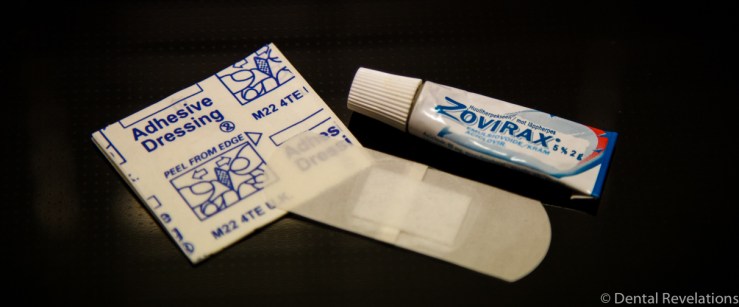
Zovirax can be used to make the cold sore heal quicker.

A patient came in for a long appointment to have a bridge done. This appointment was to include filing down the teeth to abutments which meant that the high speed drill was to be used. A lot.

High speed drills have water cooling system and this means there are aerosols in the air when the drill is used. And the aerosols carry pathogens from the patients mouth as far as two metres (about 6,6 feet) from it’s origin.

The nurse noticed that the patient had a large cold sore on a lip. Dentist appeared as if he had not noticed it and asked the patient to sit down in the patient chair. Chair was tilted back and when the dentist put his fingers inside the patient’s mouth the nurse discreetly pointed out the cold sore. The dentist carried on with the treatment and ignored the cold sore.

The nurse was worried. Very worried. And she had all the right to be. She knew the cold sore virus – herpes simplex – can easily spread to her eyes and hands, dentist’s eyes and hands, patient’s eyes and mouth via the aerosols produced by the high speed drill.

Herpes simplex virus in the eye can result in blindness.

Herpes infection on hands (herpetic whitlow) of a dentist/hygienist/nurse might force a career change as one cannot do any treatment on patients when the herpetic whitlow is active.

But the nurse didn’t have any other option but to continue with the treatment as the dentist is considered to be the one who is more educated in the matters of health and carries the responsibility of the treatment. This means the dentist makes the decisions behalf of the nurse and the patient whether to continue with the treatment or not.

Now it might be a good idea to read one of my previous post about integrity of dentists so you understand the motives behind the dentist’s decision in this story.

So on they went with the high speed drill. For an hour and a half.

Less than a week later the nurse developed a bad head ache and the next day she had sores in her mouth. Two days later she had temperature of 40 degrees and the mouth, gums and lips were full of painful sores. The GP diagnosed a primary herpes and prescribed anti-viral medicine. She was off work for a week.

When the patient with the cold sore was seen the next time in the surgery he had small blisters near the operated site.

Cold Sore Aka Herpes Simplex 

Before the anti-viral medication was developed the primary herpes used to be an infection that was often lethal. The doctors treating the patients with primary herpes could only cross their fingers and hope the patient will make through it. Many didn’t.

It can still be lethal but we have medication to treat it.

Most of the people get the primary herpes as a child and it often is asymptomatic. If contracted as an adult the primary herpes can have more difficult symptoms.

The primary herpes can be followed by secondary herpes (recurrent infection) – most commonly as a cold sore on a lip. The most frightening one of the recurrent infection of herpes simplex virus is encephalitis.

Guidelines for Treating Patient’s with Cold Sore

I asked my friend Google and she quickly found me several sites that were unanimous about what us dental professionals should do if we see a patient with a cold sore.

Do not do any treatment that can be postponed!

To convince you I copy-pasted guidelines from couple of sites.

Elective dental treatment should be deferred for patients with active lesions as aerosolization of the virus may occur during dental procedures, placing both the patient and oral health care provider at risk for possible infection or re-infection.

Elective treatment should be postponed until the lesion has healed completely. Though the patient may be comfortable after you have applied a topical medication, there is still the risk of spreading the disease to the health-care provider.

Because herpes is transmittable to patients from dental health-care professionals who have active lesions, there is a risk of spreading this disease. The guidelines from the CDC are clear. Each of us has to keep patient safety and staff safety a priority.

Conclusion

The guidelines are clear. The medical facts are clear. Why do dentists still treat patients with cold sores and risk the health of the nurse and the patient, let alone their own health? They if anyone should know how serious risk it is.

So why?

I’m afraid you might know what’s coming (especially if you read my post Morals in Dentistry). Yes, the only reason for this kind of selfish and negligent behaviour from a dentist is GREED. And perhaps small amount of twisted enjoyment of having power – being almighty in this little world that has two people the dentist can make decisions for.

When the patient walks in the surgery with a cold sore it is simply just not acceptable from the dentist’s perspective to reschedule the appointment even though everyone’s health is at risk. No, no. Profit overrides reason. Shame you who just recognised yourself.

I know there are also hygienists who see the patients with a cold sore. But this is because they don’t either know better or because they are not practice owners. Refusing to see a patient with a cold sore is not considered to be in the best interest of the practice. Plus what can you do if the patient with a cold sore just saw a dentist for a filling and is scheduled to see you for a scaling. How can you say no when the dentist said yes?

It requires lot of self confidence and experience to be able to stand up for you right to decide for your own health. Something the nurses do not have a chance to do. It proves once again how the dentist-nurse relationship is nowhere near about equality as co-workers. Not even in the matters of personal health.

I reschedule the appointment if the patient has a cold sore. And the next appointment won’t be sooner than a fortnight. I also use the opportunity to inform patient about the herpes simplex and ask patient to cancel the appointment next time when he gets a cold sore before the dental appointment.

And seriously (for all the dental professionals):

Applying Zovirax and placing a plaster on top of the cold sore before doing the treatment is just simply bonkers.

Here’s some further reading about the guidelines of seeing a patient with a cold sore.

Remember to share this post if you think there was important information that everyone should know.


You might also like

Repost with Forewords: Cold Sore Is Herpes – Cancel Your Dental Appointment Because Your Dentist Won’t!

Google for a Day – Comprehensive Answers about Cold Sore and Dentist
Are Your Dentist’s Tools Clean?