
Cold Sore Is Herpes – Cancel Your Dental Appointment Because Your Dentist Won’t!

Dental Revelations Blog-3942
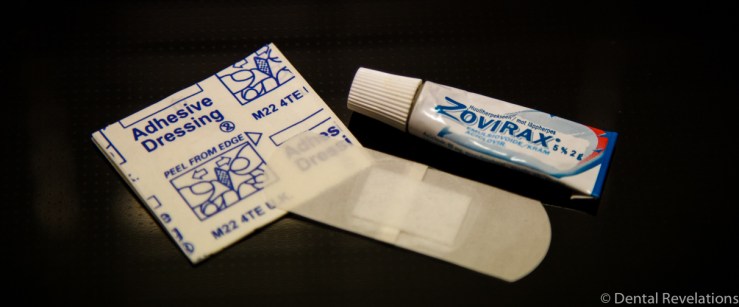
Zovirax can be used to make the cold sore heal quicker.

A patient came in for a long appointment to have a bridge done. This appointment was to include filing down the teeth to abutments which meant that the high speed drill was to be used. A lot.

High speed drills have water cooling system and this means there are aerosols in the air when the drill is used. And the aerosols carry pathogens from the patients mouth as far as two metres (about 6,6 feet) from it’s origin.

The nurse noticed that the patient had a large cold sore on a lip. Dentist appeared as if he had not noticed it and asked the patient to sit down in the patient chair. Chair was tilted back and when the dentist put his fingers inside the patient’s mouth the nurse discreetly pointed out the cold sore. The dentist carried on with the treatment and ignored the cold sore.

The nurse was worried. Very worried. And she had all the right to be. She knew the cold sore virus – herpes simplex – can easily spread to her eyes and hands, dentist’s eyes and hands, patient’s eyes and mouth via the aerosols produced by the high speed drill.

Herpes simplex virus in the eye can result in blindness.

Herpes infection on hands (herpetic whitlow) of a dentist/hygienist/nurse might force a career change as one cannot do any treatment on patients when the herpetic whitlow is active.

But the nurse didn’t have any other option but to continue with the treatment as the dentist is considered to be the one who is more educated in the matters of health and carries the responsibility of the treatment. This means the dentist makes the decisions behalf of the nurse and the patient whether to continue with the treatment or not.

Now it might be a good idea to read one of my previous post about integrity of dentists so you understand the motives behind the dentist’s decision in this story.

So on they went with the high speed drill. For an hour and a half.

Less than a week later the nurse developed a bad head ache and the next day she had sores in her mouth. Two days later she had temperature of 40 degrees and the mouth, gums and lips were full of painful sores. The GP diagnosed a primary herpes and prescribed anti-viral medicine. She was off work for a week.

When the patient with the cold sore was seen the next time in the surgery he had small blisters near the operated site.

Cold Sore Aka Herpes Simplex 

Before the anti-viral medication was developed the primary herpes used to be an infection that was often lethal. The doctors treating the patients with primary herpes could only cross their fingers and hope the patient will make through it. Many didn’t.

It can still be lethal but we have medication to treat it.

Most of the people get the primary herpes as a child and it often is asymptomatic. If contracted as an adult the primary herpes can have more difficult symptoms.

The primary herpes can be followed by secondary herpes (recurrent infection) – most commonly as a cold sore on a lip. The most frightening one of the recurrent infection of herpes simplex virus is encephalitis.

Guidelines for Treating Patient’s with Cold Sore

I asked my friend Google and she quickly found me several sites that were unanimous about what us dental professionals should do if we see a patient with a cold sore.

Do not do any treatment that can be postponed!

To convince you I copy-pasted guidelines from couple of sites.

Elective dental treatment should be deferred for patients with active lesions as aerosolization of the virus may occur during dental procedures, placing both the patient and oral health care provider at risk for possible infection or re-infection.

Elective treatment should be postponed until the lesion has healed completely. Though the patient may be comfortable after you have applied a topical medication, there is still the risk of spreading the disease to the health-care provider.

Because herpes is transmittable to patients from dental health-care professionals who have active lesions, there is a risk of spreading this disease. The guidelines from the CDC are clear. Each of us has to keep patient safety and staff safety a priority.

Conclusion

The guidelines are clear. The medical facts are clear. Why do dentists still treat patients with cold sores and risk the health of the nurse and the patient, let alone their own health? They if anyone should know how serious risk it is.

So why?

I’m afraid you might know what’s coming (especially if you read my post Morals in Dentistry). Yes, the only reason for this kind of selfish and negligent behaviour from a dentist is GREED. And perhaps small amount of twisted enjoyment of having power – being almighty in this little world that has two people the dentist can make decisions for.

When the patient walks in the surgery with a cold sore it is simply just not acceptable from the dentist’s perspective to reschedule the appointment even though everyone’s health is at risk. No, no. Profit overrides reason. Shame you who just recognised yourself.

I know there are also hygienists who see the patients with a cold sore. But this is because they don’t either know better or because they are not practice owners. Refusing to see a patient with a cold sore is not considered to be in the best interest of the practice. Plus what can you do if the patient with a cold sore just saw a dentist for a filling and is scheduled to see you for a scaling. How can you say no when the dentist said yes?

It requires lot of self confidence and experience to be able to stand up for you right to decide for your own health. Something the nurses do not have a chance to do. It proves once again how the dentist-nurse relationship is nowhere near about equality as co-workers. Not even in the matters of personal health.

I reschedule the appointment if the patient has a cold sore. And the next appointment won’t be sooner than a fortnight. I also use the opportunity to inform patient about the herpes simplex and ask patient to cancel the appointment next time when he gets a cold sore before the dental appointment.

And seriously (for all the dental professionals):

Applying Zovirax and placing a plaster on top of the cold sore before doing the treatment is just simply bonkers.

Here’s some further reading about the guidelines of seeing a patient with a cold sore.

Remember to share this post if you think there was important information that everyone should know.


You might also like

Repost with Forewords: Cold Sore Is Herpes – Cancel Your Dental Appointment Because Your Dentist Won’t!

Google for a Day – Comprehensive Answers about Cold Sore and Dentist
Are Your Dentist’s Tools Clean?
Why People Hate Teeth Cleaning at the Dentist

Dental Revelations Blog-3916
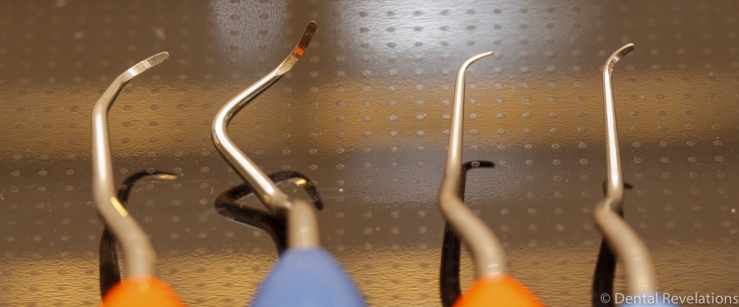
We do the teeth cleaning with these “hooks”. We like to call them curettes.

The most common things patients say to me when they enter my practice for teeth cleaning are

I hate this

It hurt a lot last time

Are you going to use the hooks??

But once we are done with the treatment they are visibly relieved, thank me for being gentle and share their story about the previous dentist/hygienist who did the scaling. The stories are horrendous and it often makes me feel ashamed of my colleagues. Why are they failing in very simple task – managing the pain?

For those who now think that I must not do the scaling very well if it doesn’t hurt:

Me being gentle does not equal me being less thorough with the scaling. I go to those 12 mm deep pockets with my hand scalers and sometimes even without any local anaesthesia. I remove all the subgingival calculus that is possible without surgery – if not on the first visit then on the following visits. And yet the patient thank me for being gentle.

How is this possible? Let me tell you how. If you are a patient, there is information for you at the end of this post.

Butchers

When I was at dental school I worked as a nurse in private practices (I have written about this period in my life in my previous post). I was a nurse for a young dentist who was performing a scaling for the patient. It was the most unpleasant piece of treatment I have ever witnessed. It was a bloodshed. A complete massacre of the gums.

The patient did not have severe gum disease – just gingivitis. The dentist did not use local anaesthesia and took her sickle and started the scaling (or her interpretation of it). Pieces of interdental papilla were flying around and the mouth was filling up with the blood… I am slightly exaggerating of course, but just slightly.

The patient was wriggling but did the dentist offer local anesthesia? No she didn’t. She carried on with the massacre. All I could do was to place my hand gently on patient’s shoulder as way of comfort in this horrible experience that should never had happened.

In the end of the treatment she had removed all the interdental papillae from patients mouth. Instead of the interdental papillae there were now dark red blood clots. Hands up everyone who knows this should not be done! I hope there are some of you.

Now this was my experience that I witnessed. The rest my patients have told me. The stories do not vary a lot from what you just read.

The Pain Threshold

All the patients are different when it comes to the pain threshold. Some people cannot take any pain and require topical anaesthesia even for probing. Some go through the whole scaling without any complaints and do not want to have a local anaesthesia even when suggested.

But the most important thing with every patient is to tell them about the options for pain relief.

When I see a patient for the first time they are often very sceptical and think they need all the possible pain relief there is. In these cases I suggest that we first try without and if the pain relief is needed it can be applied any time.

The reason I do this is that I have noticed that the fear of the pain is sometimes greater than the actual pain. Once the patients realise this they relax.

Doing It in One Go

This is not how you should do it.

When the gums are inflamed they hurt. As a patient you do not want anyone you just met digging your tender gums with a sharp instrument.

So on the first visit it is important to teach the patient better oral hygiene routines and techniques and get rid of the supragingival calculus (visible calculus) and some of the subgingival (invisible) as well (as much as the patient can take the discomfort).

I rarely use hand instruments on the first visit. I concentrate on very thorough scaling with the sonic scaler (EMS is my favourite). I might still use Mini and Micro Sickle for the lower front area as there is often calculus and stains left after the sonic scaler. Plus the patients loooove to get shiny white smile on the first visit.

Remember to tell the patient that there is (invisible) calculus still to be removed as they might not return for the following visits when the bleeding of the gums stops. It is important to mention that if the calculus is not removed it can result in periodontal abscess and bone loss. Eventually the gums will start bleeding again.

After this I let the gums heal at least for a week. It is much easier for the patient and for me to perform the subgingival scaling when the gums have healed and shrunk. Sometimes they have shrunk that much that not much of the calculus is hidden below the gum line – but this requires the patient to do his share with the oral hygiene at home.

Technique of Scaling

This is where most of the “butchers” fail. They either use wrong tools or right tools but wrong technique.

When I began working in my first surgery abroad and saw the scalers I was supposed to use I declined kindly and persuaded the owner to order me the instruments I preferred. It was a difficult task as the hygienists had used those “instruments for giants” without complaints. I explained that the curettes were far too big for anyone’s teeth. They were clumsy and big and the metal was very “stiff”. Luckily the owner was a wise dentist and I was allowed to order new ones.

The scalers I have by default for all the patients are:

Micro-Sickle by LM

Mini-Sickle by LM

Mini-Syntette by LM

With these I can do simple scale and polish but if there are pockets deeper than 3mm I have curettes at hand in a sterile pouch and I choose them by the location and the shape of the pocket. I have sets of curettes in pouches as listed below:

Mini-Gracey 11/12 by LM

Mini-Gracey 13/14 by LM

Gracey 11/12 by LM

Gracey 13/14 by LM

and

Mini-Gracey 17/18 by LM

and

Gracey 17/18 by LM

and

Furkator KS by LM

Please note that I do not get any financial benefit of writing about certain brand of instruments.

Chlorhexidine After Scaling

I always rinse the deep pockets with syringe filled with 0,12% chlorhexidine liquid or gel. It reduces the risk of complications.

Sharpening

Blunt instrument results in slipping of the instrument either to the patients gum or your finger. Neither is good. Blunt instrument also does not remove the calculus – it only polishes it.

It is very important to sharpen the curettes after each use (sickles and syntette do not require sharpening that often). It doesn’t matter if you do it by hand or by sharpening machine. Both of them require skill but the only difference between these two is that the hand sharpening extends the life expectancy of the curette.

I sharpen my instruments in a cycle of hand sharpening two to three times in a row and then machine sharpening once. I sharpen once a week all the instruments that have built up in a week. For you being able to do this you need at least a week’s worth of instruments in the surgery.

Tip: When you sharpen your instruments always check with a test stick first if the instrument is in fact sharp enough. Sometimes if you have used the instrument only for couple of strokes it remains sharp.

Informing the Patient About the Post-Scaling Complications

There will be tender gums after any scaling and polishing. But the patients can take it much better when they are informed about the different kinds of complications that might occur and how they can manage them.

The most common complications and ways of relieving them are:

  • tender gums – cold drinks/food, paracetamol/ibuprofen, never aspirin as it might make the gums continue bleeding
  • taste of blood in the mouth – normally it is resolved by the next day
  • sensitivity to cold – sensitive toothpaste, leaving the toothpaste in mouth after brushing, avoiding acidic food/beverages

It is also good idea to mention the less common complications and the ways of relieving them:

  • extreme pain in the gum caused by secondary infection that lasts for many days – salt water rinse, chlorhexidine rinse (alcohol free) or to see your dentist if the symptoms persist
  • pain around the partly erupted wisdom teeth – chlorhexidine rinse or to see your dentist if the symptoms get worse despite the rinsing
  • periodontal abscess – to see the dentist

If the patient is left untold about these complications and if they do happen it is very likely that the patient blames you. And he will tell this to ten of his mates (marketing rule) even though there was nothing wrong with your scaling skills.

But when explained that you have now disturbed the bacteria balance in the deep pockets by scaling and even though it was necessary and important thing to do the bacteria in the pockets sometimes – in rare cases – do not like it and the situation might get worse, you will have much more satisfied patient even if complications occur. A patient that still trusts you.

Conclusion

Having the teeth cleaned at the dentist should not be painful. Some discomfort is acceptable but it should always match to the patient’s individual pain threshold. And after the scaling the patient’s gums should not look as if Jack the Ripper had done the treatment.

The right technique of the scaling is difficult to master. But once you do, it will be more rewarding for you as you see better healing results with the gums and a happier patient. Here’s one video about hand scaling technique (it’s not ideal video but hopefully you get the idea) but I’m sure hands on courses are available at the dental schools as well.

For the hygienist – please do not accept just any hand scalers. Check out different brands of curettes at the dental show case and order couple of them to try out. If you are unsure with your technique start with the mini-curettes.

For the patient – If you’ve had bad experience at the dentist with the cleaning of the teeth seek another one. Change until you get proper cleaning, relevant info and oral hygiene instructions. Be prepared to have at least two visits.

When you maintain good oral hygiene habits and see your hygienist for regular teeth cleanings (interval decided individually, see my previous post) you will never ever need to go through the same experience again. It takes just one visit to clean your teeth and it is much less painful.

If you do not do your part at home and leave longer period of time than recommended between the cleanings it often takes two visits to do it. And once again it is unpleasant for you.

I worry over the fact that the patient is unable to tell if the scaling was done thoroughly. I have written about this before. It is not until the patient by chance sees somebody who recognises the gum disease and masters the comprehensive treatment for it, when they realise the poor quality of the treatment they were getting in the previous practice.

That, my dear readers simply is not acceptable in the modern dentistry. So revise, revise and revise. Trust the patient’s reaction. If they complain often that it was a horrible experience then something is wrong with your scaling technique, your tools or your chair side manner. Swallow your pride and do something about it.


Do You Recommend Toothpick?

Dental Revelations Blog-24529
Toothpick or no toothpick, that is the question!

I will once again return to the times when I was a student in dental school and knew only little of the dentistry.

We were learning about cariology and were advised to bring in dental radiographs (x-rays) if we had any. I had had a panoramic radiograph taken recently and the teacher – a specialist in cariology – took a look at it. He said to me:

“You should use a toothpick”

I was very surprised and said to him that there is no way I can fit the toothpick in between the teeth. He showed me from my x-ray that there is enough space between the teeth for the toothpick. But I was not convinced (thought that he was wrong) and carried on using a floss for many years to come.

The reason why this occasion came to my mind was that I was reading through health and dental blogs to get ideas for my next topic and I ran into several blogs that wrongly advice people against using a toothpick. I got this certain annoyed feeling inside of me and I knew I had to write about it.

Toothpick Widens the Gaps Between the Teeth and So It Is Supposed To

I have worked with many periodontists and learned that floss is not – by far – the right tool when we try to tackle the gum disease. It does no massaging for the gums which is needed when we try to make the gums firmer around the teeth (plus it won’t remove all the bacteria). When the gum gets firmer it shrinks and leaves less space for the bacteria to hide and cause the disease.

When I moved abroad I very quickly understood that a toothpick was not considered to be a good tool for cleaning between the teeth. I received wondering commentary from my colleagues when they realised I am recommending it. It was considered to be old-fashioned, ineffective and even harmful to the gum. I had to explain the reasons for recommending it again and again:

“The toothpick – the triangle-shaped wooden one –  works well initially when the patient has inflamed and swollen gums. It is cost-effective, easy to use and effective in massaging the loose gum. Once the gums have healed and firmed up we can determine better which sizes of interdental brushes are the best ones to use.”

The patients often fear that whatever they are using to clean between the teeth will widen the gaps. I tell them that it might actually happen but in that case it is only a good sign. I explain to them – with their x-rays – that the bone levels will determine how much the gaps between the teeth will widen.

If the bone around the tooth has receded as a result of the bacteria presence and inflammation and there is swollen and loose gum on top of it, it is an unhealthy situation and will result in more bone loss eventually. The gum needs to be firm on top of the bone so that it can better resist the bacteria.

And the only way to get firm gum is by massaging it. This can be done with the triangle-shaped wooden toothpick by pushing it gently but firmly between the teeth as far as it goes and repeat it couple of times. If there is bleeding at first it is also a good sign – the toothpick is doing its job. The bleeding will stop if the toothpick is used for a week in every between the teeth every night.

Suspicion

People often leave the practice unconvinced of the advice they were given. But the ones that do as they were told despite being sceptical are gobsmacked by the way the bleeding (and hurting) stopped.

I recall having a phone conversation with a patient who had an advanced gum disease and who had recently seen me for the first visit of the course of treatments. I had advised him to use purple interdental brush (1,1mm) but he wasn’t convinced about it and this was the reason for to phone call. He thought the brush was too big as it hurt. I told him that the only thing he can do is to try to prove me wrong. To follow my advice and see if I’m wrong.

He carried on using the interdental brush and about week later I received another phone call from the patient. He wanted to share his amazement and joy about his gums that had stopped bleeding. He was thankful for the correct advise and said that he had suffered from bleeding gums for all his life and only now – at his fifties – he managed to stop the gums bleeding.

The pain makes people think that something they use is not right for them. That’s why it is important to advise patients that when they have a gum disease (any stage from gingivitis to severe periodontitis) it will be painful at first when they begin using the interdental brush or toothpick – there’s no way around it. I always tell patients that for about week they need to suffer from tender and sometimes very painful gums. But if they persevere with the use of interdental brush/toothpick as advised they will notice it won’t hurt after a while.

 Conclusion

I have said this before and I am saying it again – do not believe everything you read from the internet. I have run into several sites that offer wrong advise on oral health. Even dental professional offer wrong advise. Here’s one example about advise against the use of toothpick

The sharp surface area might destroy the polish of the tooth, damage the gums or perhaps create the voids in between the teeth to broaden.

A correct technique of any product recommended needs to be established at the dental practice before patient leaves the practice. Toothpick can cause harm to the gum if used incorrectly but so can floss, interdental brush and toothbrushes. I have pointed out two times in this post that the toothpick needs to be the triangle-shaped one if it is used in between the teeth. Never use cocktail sticks!

Also a toothpick should be used only temporarily as it won’t remove all the bacteria from between the teeth for the same reasons as the floss doesn’t. Neither one of them cannot get into the grooves of the teeth (area where the roots start to separate) and the grooves of the fillings.

I will emphasise that a toothpick is perfect in the beginning of the periodontal treatment when the swelling of the gum needs to be reduced.

Finally back to my teacher who advised me to use toothpicks. He was right. Of course he was – he had decades of experience. I was just a cocky rookie in dentistry and thought I knew better.

It wasn’t until I had periodontists as colleagues when I realised that I need to use something else than a floss. My bone level around the teeth was naturally that low that I could fit in a toothpick and later I moved on to the interdental brushes (size 0,7mm). I have used them for over a decade now and haven’t used floss since – and no, I have not developed any decay in the contact point of the tooth.