Part I: Is It a Skyskraper? No, It’s Your Ego

Dentalrevelations

On my second post I promised to write about personalities of the staff in dental practices and how they may affect the dental practice and the treatment given to the patient. I’m going to fulfil this promise today. And on my next post. And the next.

I am going to write a series of posts about this topic. Each post will have a viewpoint of one dental professional. Today it will be the hygienist’s.

I’m Not Going to Play with You

As long as there have been dental hygienists there have been dentists who are afraid of losing their living because of them. These dentists either refer only the simple scale and polish to the hygienist or do not refer at all.

They treat the patients with advanced gum disease themselves as it requires more visits. More visits equals more money per patient. And the money is the only motive they have for this silly way of practicing the dentistry.

The problem with these kinds of dentists is that most often the hygienist would have better skills to treat the advanced gum disease than the dentist and this is revealed when the patient sees the hygienist six months later. Often there is subgingival (invisible) calculus still left even though it should have been removed on the first course of treatment. Plus the patient has no clue how to clean her teeth effectively.

Big Ego

It is a fact that the oral and maxillofacial surgeons have a big ego. Or to precise – they have a huge ego. But in my opinion they have all the right to have one. They NEED one to be able to perform all the talent requiring hocus pocus on patients mouth, jaw and face. Plus they don’t use their ego against co-workers or the patients.

But when a dentist has a big ego it rarely is attractive or talent enhancing. I will give you an example from a real life.

A dentist does a check-up for a patient. Then the patient sees a hygienist for a scale and polish. Whilst scaling with curettes the hygienist notices there are potential cavities in three different sites and she checks the patient’s x-rays. The x-rays confirm the suspicion.

The hygienist checks the dentist’s notes for the check-up visit to see if there is a treatment plan to fix these cavities. There isn’t. It appears as if the dentist has missed the cavities when doing the check-up.

The hygienist sends the patient back to see the dentist. When the dentist sees the hygienist’s message about the cavities he acts as if the patient has come in unnecessarily.

“I’m sure there’s nothing there”

he says to the patient. He quickly checks the sites with a mirror, sighs and continues by saying

“One of these suspected cavities is a borderline cavity. We could do a filling for that so that you didn’t come this far for nothing. The other two we can still monitor.”

The hygienist sees a patient for another scale and polish couple of weeks later. She checks the dentist’s notes and realises that only one cavity has been filled. She asks the patient if the dentist has asked her to come back to have the other two to be done. Negative.

The hygienist is baffled. She checks again with her curette the other two suspected cavities. The instrument goes between the filling and a tooth and sinks deep into a soft area – it is a cavity for sure.

The hygienist decides to ask another dentist to come and have a look there and then. The dentist confirms the two remaining cavities and recommends the patient to have them filled.

At this point the patient is very confused. Who is not doing their job properly? Who to believe?

This was just one example. There are plenty more but I won’t write them down as I am not writing a novel. But my point is that when a lower ranking dental professional finds something the almighty dentist didn’t the ego goes before the patient’s best interest.

Not good. Not good dentistry at all and everyone who recognise themselves from this should be ashamed.

But why the dentist did not notice the cavities even from the x-rays? That is completely another story.

Hygienist’s Difficult Role

It is tough to be a hygienist. They often have skills to make the same diagnosis as the dentists but only the dentists have a right to make one. The hygienist must always remember to add a question mark after their findings or the hell will break loose and she is quickly put back to her place by the dentist who kindly reminds her that she has no right to make a diagnosis.

And when she finds something that the dentist missed she will be between rock and a hard place. Especially if the dentist does not agree with her because of the big ego problem. The confused patient often thinks the dentist was right which makes the situation even more difficult.

But the time is on hygienist’s side. She has recorded every finding on the patient’s dental records – with the question marks! She has recorded that she has consulted a dentist. Sooner or later the cavity (or whatever her finding was) will get worse. There will be pain. Or the crown will come off as the cavity has eaten the tooth under it and perhaps so much so that it is beyond repair.

The dentist can only hope the patient do not file a complaint.

Lonely Rider in a Cupboard under the Stairs

Another side of being hygienist is the fact that they are often quite alone in the practice. It is often so that the practice has only one hygienist. This means they don’t have peer support in the practice. Peer support is something that every dental professional would need.

Also the hygienist is given the oldest dental unit in the practice and the smallest room, the one without a window. Or perhaps the room under the stairs. Not sure if the Harry Potter fate has happened for real – perhaps it was just sarcasm from a hygienist that I once knew?

Conclusion

Why do the dentists feel so threatened by hygienists? Why is it hard to be wrong or admit that you have missed something? Why do they need to feel and let others know that dentists are at the top of the command chain?

I’m afraid I do not have the answers. One dentist once said to me that the dentists are non-qualifiers for medical school which means that the dentistry was not their first choice of profession. Are these kinds of dentists letting everyone else suffer for their disappointment?

I will remind you that not all the dentist are like this of course. But in my current workplace two out of four dentists are. That’s 50%. That’s a lot!

I hope practice owners will start to value their hygienist more than before. And get them the brand new dental unit, a saddle chair (or whatever chair the hygienist prefers) and curettes the hygienist wants so that there would be even a small chance to work in an ergonomic position during the treatment. After all they bring in steady flow of cash with very little expenses.

And dear dentists, we are all equal human beings no matter what our profession is.


You might also like these posts:
Part II: Just Another Day at the Office
Part III: I’m Sorry but I Did Not Get Qualified So That I Can Make Coffee for You
Cold Sore Is Herpes – Cancel Your Dental Appointment Because Your Dentist Won’t!

Dental Revelations Blog-3942
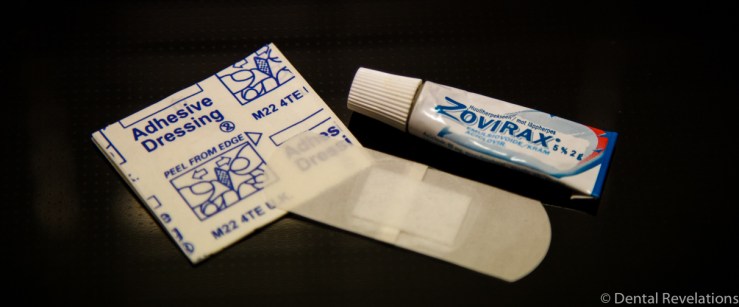
Zovirax can be used to make the cold sore heal quicker.

A patient came in for a long appointment to have a bridge done. This appointment was to include filing down the teeth to abutments which meant that the high speed drill was to be used. A lot.

High speed drills have water cooling system and this means there are aerosols in the air when the drill is used. And the aerosols carry pathogens from the patients mouth as far as two metres (about 6,6 feet) from it’s origin.

The nurse noticed that the patient had a large cold sore on a lip. Dentist appeared as if he had not noticed it and asked the patient to sit down in the patient chair. Chair was tilted back and when the dentist put his fingers inside the patient’s mouth the nurse discreetly pointed out the cold sore. The dentist carried on with the treatment and ignored the cold sore.

The nurse was worried. Very worried. And she had all the right to be. She knew the cold sore virus – herpes simplex – can easily spread to her eyes and hands, dentist’s eyes and hands, patient’s eyes and mouth via the aerosols produced by the high speed drill.

Herpes simplex virus in the eye can result in blindness.

Herpes infection on hands (herpetic whitlow) of a dentist/hygienist/nurse might force a career change as one cannot do any treatment on patients when the herpetic whitlow is active.

But the nurse didn’t have any other option but to continue with the treatment as the dentist is considered to be the one who is more educated in the matters of health and carries the responsibility of the treatment. This means the dentist makes the decisions behalf of the nurse and the patient whether to continue with the treatment or not.

Now it might be a good idea to read one of my previous post about integrity of dentists so you understand the motives behind the dentist’s decision in this story.

So on they went with the high speed drill. For an hour and a half.

Less than a week later the nurse developed a bad head ache and the next day she had sores in her mouth. Two days later she had temperature of 40 degrees and the mouth, gums and lips were full of painful sores. The GP diagnosed a primary herpes and prescribed anti-viral medicine. She was off work for a week.

When the patient with the cold sore was seen the next time in the surgery he had small blisters near the operated site.

Cold Sore Aka Herpes Simplex 

Before the anti-viral medication was developed the primary herpes used to be an infection that was often lethal. The doctors treating the patients with primary herpes could only cross their fingers and hope the patient will make through it. Many didn’t.

It can still be lethal but we have medication to treat it.

Most of the people get the primary herpes as a child and it often is asymptomatic. If contracted as an adult the primary herpes can have more difficult symptoms.

The primary herpes can be followed by secondary herpes (recurrent infection) – most commonly as a cold sore on a lip. The most frightening one of the recurrent infection of herpes simplex virus is encephalitis.

Guidelines for Treating Patient’s with Cold Sore

I asked my friend Google and she quickly found me several sites that were unanimous about what us dental professionals should do if we see a patient with a cold sore.

Do not do any treatment that can be postponed!

To convince you I copy-pasted guidelines from couple of sites.

Elective dental treatment should be deferred for patients with active lesions as aerosolization of the virus may occur during dental procedures, placing both the patient and oral health care provider at risk for possible infection or re-infection.

Elective treatment should be postponed until the lesion has healed completely. Though the patient may be comfortable after you have applied a topical medication, there is still the risk of spreading the disease to the health-care provider.

Because herpes is transmittable to patients from dental health-care professionals who have active lesions, there is a risk of spreading this disease. The guidelines from the CDC are clear. Each of us has to keep patient safety and staff safety a priority.

Conclusion

The guidelines are clear. The medical facts are clear. Why do dentists still treat patients with cold sores and risk the health of the nurse and the patient, let alone their own health? They if anyone should know how serious risk it is.

So why?

I’m afraid you might know what’s coming (especially if you read my post Morals in Dentistry). Yes, the only reason for this kind of selfish and negligent behaviour from a dentist is GREED. And perhaps small amount of twisted enjoyment of having power – being almighty in this little world that has two people the dentist can make decisions for.

When the patient walks in the surgery with a cold sore it is simply just not acceptable from the dentist’s perspective to reschedule the appointment even though everyone’s health is at risk. No, no. Profit overrides reason. Shame you who just recognised yourself.

I know there are also hygienists who see the patients with a cold sore. But this is because they don’t either know better or because they are not practice owners. Refusing to see a patient with a cold sore is not considered to be in the best interest of the practice. Plus what can you do if the patient with a cold sore just saw a dentist for a filling and is scheduled to see you for a scaling. How can you say no when the dentist said yes?

It requires lot of self confidence and experience to be able to stand up for you right to decide for your own health. Something the nurses do not have a chance to do. It proves once again how the dentist-nurse relationship is nowhere near about equality as co-workers. Not even in the matters of personal health.

I reschedule the appointment if the patient has a cold sore. And the next appointment won’t be sooner than a fortnight. I also use the opportunity to inform patient about the herpes simplex and ask patient to cancel the appointment next time when he gets a cold sore before the dental appointment.

And seriously (for all the dental professionals):

Applying Zovirax and placing a plaster on top of the cold sore before doing the treatment is just simply bonkers.

Here’s some further reading about the guidelines of seeing a patient with a cold sore.

Remember to share this post if you think there was important information that everyone should know.


You might also like

Repost with Forewords: Cold Sore Is Herpes – Cancel Your Dental Appointment Because Your Dentist Won’t!

Google for a Day – Comprehensive Answers about Cold Sore and Dentist
Are Your Dentist’s Tools Clean?

Don’t Let Just Anyone Touch Your Occlusion

Dental Revelations Blog-3878

Grinding or clenching of the teeth is a very common problem. It is a nasty problem for its bearer as it causes pain in the muscles and in the jaw joint, headache, toothache and even disturbed sleep at night. If nothing is done to the problem the teeth will eventually suffer from the grinding especially if the occlusion is imbalanced. There will be a recession in the gum, worn enamel, chipped enamel and periodontal problems to start with.

So if you do know that you grind or clench your teeth at night – or even more so if you clench your teeth during the day which is a definite sign that you do it also at night – go to see your dentist. But here’s an important advice:

Do not go to see just any dentist. Find a specialist in that has done 3 extra years of stuyding to gain the title prosthodontics (even better if one has a PhD).

Why? I will tell you the reasons from my own experience.

My First Mouth Guard Or Should I Say Bite Block

I am a dental professional and in my early career I was quite naive and thought that all the dentist can do all the stuff they are taught at school. I was so wrong.

In my first year after graduation I had a bite guard made by a regular dentist in my practice. I soon realised it wasn’t perfect and sought help from a specialist in prosthodontics who was working in our practice.

The first thing the specialist did was that he filed away about 0,7 cm (0,28 inches) of the hight of the bite guard without fitting it in the middle of the filing. Once he was done with the filing he started to adjust it to my occlusion. He was covered with acrylic dust and he did lots of eye rolling and head shaking.

He told me that the bite guard is not ideal and it would be better to have it redone. I never really used it after that and I carried on suffering from the grinding and clenching of the teeth.

My Second Mouth Guard – When Desperate You Accept Anything

Couple of years later I lived in another country and once again sought help from a dentist for the grinding. She recommended me an anterior night guard (also known as NTI or MCI) which she did routinely for every patient suffering from grinding.

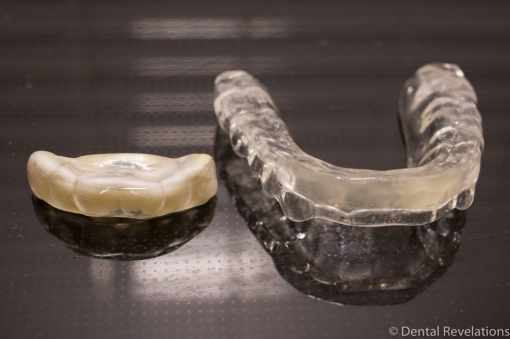
Now I tried to find you a web site that had a photo and impartial info about anterior night guard but wasn’t able to find one. So I took a photo of mine. I must apologise that the device is not in a mint condition anymore. There is my current mouth guard (that I will tell you more about later in this post) in the photo for comparison.

Dental Revelations Blog-2
NTI/MCI/anterior night guard on the left

I felt this anterior night guard – I will call it MCI from now on – relieved the symptoms I had. I was very happy about the dentist and the MCI. Until I spoke to a former colleague of mine, a very good dentist.

He warned me that I was in risk of developing an anterior open bite due to a use of MCI. I did not second guess him once he explained the reasons.

With MCI the back teeth do not make contact. And when the teeth don’t make a contact with the opposite side they will erupt while the front teeth are kept in place by MCI. The over-erupted back teeth cause the open bite in the front. Simple as that.

We’ve all seen what happens to a tooth that lacks an opposing partner in occlusion. It over-erupts!

So I got an advice to use the MCI for 2 weeks and then keep 2 weeks break to avoid the over-erupting back teeth. So I did. But it did not keep the symptoms of grinding at bay.

My Third Mouth Guard Was Almost What It Should Be

Five years later I was back in my home country where I was advised to have a mouth guard done by a dentist in my practice. I did and she removed my upper wisdom teeth so that it was easier to have the mouth guard done. Once I received the mouth guard I didn’t feel it was helping me at all.

At this point I had had enough of the dentists in this matter and decided to see a specialist in prosthodontics. One that was known to be a good one.

The specialist did a careful examination on my teeth and the mouth guard. He said the mouth guard was ok’ish and that he just needed to adjust it. I also showed him my MCI which he advised to use only as emergency basis and only 4-5 days in a row.

I told to the specialist that I have a feeling that only my last molars were in contact. He checked it and said there was no imbalance – meaning that my bite was as it should be. I also asked if I should do the exercise for the jaw muscles. The specialist said there is no benefit of it.

I had to return to see the specialist every 6 months and every time he adjusted the mouth guard and charged quite a lot even compared to the specialist’s fares.

After 3 years of using the mouth guard there was a hole in it. I had apparently “bitten” through it. It was time to have a new mouthguard done.

My Fourth And Current Mouth Guard

For one reason or another I did not completely trust the specialist I had been seeing so I asked for recommendations of specialists from my colleagues. Based on the recommendations I went to see a specialist in prosthodontics and stomatognathic physiology – she had PhD too!

I was kinda shy when mentioning that I have a feeling that only my last molars were in contact – well hell yeah, one specialist had told me I was imagining things.

Only this time I was told I was right. She also told me that I have a partial anterior open bite. I was flabbergasted. I knew that not all the dentist master the matters of occlusion but even the specialists get it wrong!

And once she had done her magic about my occlusion by balancing it I felt the difference immediately.

By the way – my intact upper wisdom teeth were unnecessarily removed by the dentist who made my third mouth guard. A mouth guard can be done with the wisdom teeth in place as long as they are nicely positioned as mine were.

So after I had my occlusion sorted out I got my new bestest of the best mouth guard. It is amazing I must say. It brought me an immediate relief. But I was only half way through the treatment.

I was booked to see a dental hygienist who did massage for the muscles of the jaw in 3 separate visits and gave instructions (based on the specialist’s recommendations) on how to exercise the muscles by stretching and strengthening them. I realised that having a mouth guard is not enough. It won’t take away the root cause of the grinding which in my case was the weak muscles that did not support the jaw.

The MCI I was not allowed to use again. I did not argue with that.

Conclusion

I, a dental professional had three mouth guards (including the MCI) done until I got a proper one. None of the dentists I saw for the mouth guard had a clue about occlusion or what is the best treatment for it. The second specialist was only concentrating on the mouth guard and did not find the imbalance in my bite. Naughty naughty. I guess he was concentrating in money making – I sense these things as I am HSP – and that was probably one reason I didn’t go back to see him.

I worry over the patients who do not have an understanding of what is right treatment for grinding and clenching of the teeth. There are lots of people using MCI every night and they have been using it for years and years. Do they realise that the open bite they have developed is caused by the use of MCI? No they don’t as the dentist won’t necessarily tell them – especially if the patient is seeing the same dentist who recommended the MCI (see my previous post about this phenomenon). And it is not guaranteed that another dentist will tell either.

Also very commonly the treatment dentists offer for the grinding is the mouth guard. And only the mouth guard. But that is never enough! The best thing any dentist can do for the patient who is suffering from the grinding is to REFER to a specialist.

Important information for the patients: You can make a self referral to a specialist by simply booking an appointment. They will not say no to the new patients. Be prepared to pay more for the mouth guard but it is money well spent.

The occlusion is a delicate thing. I always advice patients not to let just anyone adjust the bite. It can go from bad to worse. You are in better hands when seeing a specialist in prosthodontics. The higher educated one the better – in any health matter.

I learned my lesson the hard way. I suffered from the grinding for many years. I lost two intact wisdom teeth unnecessarily. And I can’t help but think that the malocclusion on my back teeth and the partial anterior open bite were caused by the MCI. There was a dreadful moment when the specialist was thinking that I might need crowns for my intact canine teeth to fix the open bite and to get enough support for the side movements of the jaw. So I can count myself as lucky that the malocclusion could be fixed by simply filing the teeth.

Phew!


You might also like

Eeny Meeny Miny Moe – Which Type of Tooth Wear?