
Years of Malpractice – How Is It Possible?

dental-revelations-blog
Where there is smoke, there is fire. Dentists negligent behaviour should be act upon.

Ever wondered how it is possible that the dentists who are not practicing dentistry up to the standards get caught only after years of practicing the profession? Well you have come to the right place to find out.

Is It the Patients’ Fault?

Nope. Absolutely not.

The patients cannot tell the difference between a good and bad dentist when it comes to the skills of a dentist. Or if the procedures have been done as they should and if they are necessary in the first place. Or if the instruments entering their mouth have been properly cleaned (take a look at my previous post about this).

An average patient can only judge the dentist by the looks of him and the practice, and by the dentist’s chair-side manners. The rest is build on a trust of receiving good and adequate care. But every once in a while this trust is broken and the dentist ends up in the headlines.

But please remember that not all the dentists ending up to the headlines are rogue dentists as I have written previously.

Collegiality Gone Bad

Collegiality between the dentists means respect to one another’s abilities to work towards the same purpose. Helping patients. But collegiality has an ugly side as well. It is an unwritten code between the dentists which means one should not interfere or especially under any circumstances criticise a fellow dentist’s work. It is a code one should not break. The hygienists are expected to play by the same rules.

Now, this creates a problem. When a dentist is underperforming, the colleagues hear this from the hygienists and nurses. They see see it from the teeth of the patients who come too see them instead of their regular dentist (e.g. for emergency visit or whilst the regular dentist is on a holiday). They know there is a problem but very rarely they raise questions.

Instead the patient is kept under an illusion that the regular dentist has made the right decisions by distorting the truth.

Distorted truth:

“This decay is in such a difficult area to notice.”

The truth:

“This massive decay is so big that even my half-blind grandmother would find it.”

Distorted truth:

“Your dentist has marked it as an early decay, something to be kept an eye on… it has now grown bigger and needs a filling.”

The truth:

“Your dentist needs to have his eyes checked. This decay should have been filled ages ago. If you are lucky enough, you avoid the root canal treatment.”

Conclusion

It should be every dentist’s duty to report problems in colleague’s way of practicing dentistry. The Code of Ethics by ADA state the following:

Dentists should be aware that jurisdictional laws vary in their definitions of abuse and neglect, in their reporting requirements and the extent to which immunity is granted to good faith reporters. The variances may raise potential legal and other risks that should be considered, while keeping in mind the duty to put the welfare of the patient first. Therefore a dentist’s ethical obligation to identify and report suspected cases of abuse and neglect can vary from one jurisdiction to another

In my opinion, you don’t pull out the biggest guns if you suspect negligent behaviour from your colleague. The dentist in question should be given adequate time to correct the problem e.g. by revising.

The privilege of dentists to be accorded professional status rests primarily in the knowledge, skill and experience with which they serve their patients and society. All dentists, therefore, have the obligation of keeping their knowledge and skill current.

If nothing changes, more severe means should take place. This includes giving warnings and as a last resort filing a complaint to the relevant authorities.

Naturally, if the negligence is severe, one should not hesitate to contact authorities urgently.

The bible of dentistry aka ADA’s Code of Ethics 2018 in full.


You might also like
Morals in Dentistry

Where It All Started

Are Your Dentist’s Tools Clean?

20161208_093300-1
It is extremely unlikely that you get HIV from a dentist appointment.

Fox6Now.com: Tomah VA dentist accused of using improperly cleaned tools resigns

I shouldn’t read news as I always have something to say about them. This news above reminded me about working in the UK and how the instruments were cleaned there.

This Thomas VA dentist is not the only dentist that is underperforming in the instrument cleaning. There are dentists who have read this news and have wiped sweat from their foreheads and thanked their lucky stars it wasn’t their name on the headlines. Honestly!

Let me tell you how things were done in six of the practices I used to work in the UK. I will first go through the correct way of cleaning the instruments.

This I How It Should Be Done

1. Disinfect the contaminated instruments preferably in a washer disinfector like Miele Dental Disinfector

With this washer disinfector the cleaning job is half done. You just put used instruments within 4 hours of using them to the washing cycle and you get disinfected instruments in less than an hour (no need to soak them in anything prior the cycle).

No scrubbing is needed which will minimise the accidents of nurses cutting themselves.

2. Dry the instruments thoroughly. Use pressurised air on all the hard-to-reach areas like matrix retainers, sonic scaler tips, forceps.

3. Place the instruments that  don’t need to be sterile on the metallic tray to be autoclaved. Put the instruments that need to be sterile in pouches and close the pouches.

4. Put all the instruments in an up-to-date vacuum autoclave and run the cycle. Once they are cooked, put them in cupboards or drawers to be picked to the surgeries.

Simple and pathogen-free tools.

This Is How It Should Not Be Done

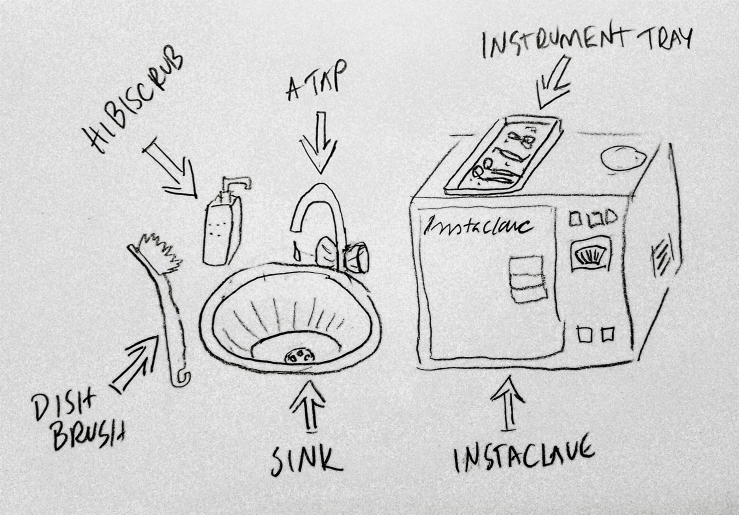
None of the surgeries I worked at in the UK had washer disinfector. Instead there was a dish brush and Hibiscrub. Yes, you read it correctly. Hibiscrub was used like washing up liquid on dish brush and the instruments were washed over a sink in the surgery. But this was done only up until health and safety regulations stated that using dish brush was a health hazard – there was too big risk of an injury from sharp instruments.

Once the instruments were brushed with Hibiscrub and rinsed with water, the instruments were placed on metallic trays (no drying) and put in the Instaclave, the simplest of the simplest model (non-vacuum). If there were surgical instruments, they were either put on the pouches and put on trays without closing the pouch. The pouch was closed after the cycle in the Instaclave. Sometimes the surgical instruments were put on the trays without pouches and once they had gone through the cycle, the nurse put them in the pouches that were taken straight from the package. This of course meant that the pouch was non-sterile as it had not gone through the cycle in the autoclave. Non-sterile pouch equals non-sterile instrument – no matter if the instrument has gone through the cycle.

So needless to say that many things went wrong. And let me clarify that all the above was done in the surgery. Every surgery had their own autoclave – just about five feet away from the patient.

20161207_234528
This was the typical setup in the dental surgery in the UK for cleaning tools used on patient

The Question: Did I Do It Too?

Well, as much as I think that you live by the rules of the country you are in, I did not follow this questionable way of cleaning instruments. I did inventory on surgery’s storage room and found a container with a lid. I asked the practice manager to order me instrument disinfection liquid. I had to do some convincing before the liquid was ordered – understandably of course as no-one else was using one. So why should I?

So all my instruments were brushed with dish brush under running water and then placed into this container which had disinfection liquid in it. The instruments were kept in there for the recommended time, rinsed with water, dried and then put in the Instaclave.

Not perfect, but enough for me to have a clean conscience.


If you liked this post, you might also like:

It’s ok to swallow, it’s only water… Or is it?

Christmas Came Early

dental-revelations-blog
Philips Sonicare forever!

I got bribed today. Big time. Remember the representative who got to the wrong side of me? If not, visit here to read the story before you continue further.

I said she was not going to visit our practice if it was up to me. Well, turns out it wasn’t up to me. The others wanted her to come. We had run out of toothpaste samples because the toothpaste manufacturers have started to be rather stingy recently. Perhaps the economic depression has hit them as well? I have noticed this phenomenon also at the dental show cases. Couple of years ago you could get lots of freebies but this year you needed to fill in a questionnaire or a competition to receive one travel sized tube of toothpaste. I didn’t bother.

Anyway, I was not looking forward to this rep coming to our practice as the previous meeting did not go that well. And when she came in, I realised she thought so as well.

First she complemented me about my looks. She did not compliment anybody else. And for your information I do not look like Snow White and the rest of the staff like the seven Dwarfs. So my interpretation of this was that she was trying to break the ice.

Then she began the presentation. Having learned my lesson last time I only listened and did not ask anything. I replied if she asked me a question.

I must say the new electric toothbrush she was demoing to us was quite impressive. It was up-to-date with the smart phone application and the position detection. The only questionable feature was the smart phone holder. It has a suction cup that is supposed to hold my 700+$smart phone at the hight of my face. I dared to ask about it and the rep said it will hold any smart phone as long as the surface is smooth and clean (should be preferably wiped with alcohol prior attaching the holder to the tiles or a mirror – but still I would not attach my smart phone to the holder).

Then she moved on to the toothpastes. Oh dear god how many different kinds of toothpastes they had. Too many in my opinion. The professionals won’t remember which one was for which problem and the patients will be even more confused – like one of my patient said to me

“I went to look for the sensitive one but couldn’t find it anymore. Instead there was so many new ones that I did not buy anything.”

Turns out that they have discontinued the sensitive one. Why didn’t they stick to the one that was supposed to deal with all the problems in mouth?

Then she gave us samples of one of the new toothpastes. She wanted us to try it out and report to her what we thought about it. Naturally she praised the toothpaste while I was browsing through the ingredients. Zinc lactate! Zinc in toothpastes can cause dry mouth. I felt the urge to mention it but remembered our last meeting when I did so. So I stayed silent.

But then came the grande finale. She took out the new, top of the line electric toothbrush and handed it to me with words

“I’m afraid I have only one of these to give out and I thought that it should be you.”

I felt the others staring at me in disbelief but all I could do was to look at the shiny and sleek black packaging she was handing to me. And without hesitation I accepted the gift.

Now, I am not sure what all of this meant. Was she trying to make up the last encounter? Or was she trying to convert me? Could she remember out of hundreds of customers that I am THE ONE not using their toothbrush? That would be scary.

If she tried to convert me, she could not have picked a worse target. I may accept gifts, try them out as expected but I cannot be bribed. I doubt there will ever be better electric toothbrush than my beloved Philips Sonicare.