Vanity with Style? Should You Get Tooth Jewellery?

wp-1486140029293.jpg

Human beings have been interested in their appearance for thousands of years. Decorating their bodies with tattoos, piercing ears and other parts of body but also decorating their teeth. Already 2500 years ago were the Native Americans making their teeth stand out with gems. This is a phenomenon that has lasted ever since.

Tooth Jewels – Any Harm?

Well in the mid-nineties I had my first tooth jewel. I was a dental student when the tiny golden figures for the teeth came in fashion. Heart, star, droplet were the figures to choose from. I chose a heart and it was attached to my upper right incisor with a bonding adhesive they use to bond the filling.

For a very long time I was happy with it but then I saw other people who had similar jewellery on their teeth. I thought it looked like people had something stuck on their teeth that needed to be scraped off with a finger nail. It didn’t look like you had golden figure on your tooth and the shape was only visibly in very close distance. I did not want people to think I had food stuck on my teeth – after all I was working as a dental professional already.

But then! I saw somebody having a diamond on his tooth and I was sold there and then. It wasn’t a diamond inserted on a golden figure or a diamond glued on the surface of the tooth. It was a diamond that was planted inside the tooth – to the level of the surface of the enamel.

So I went to a jewellery shop and asked for a small diamond. I asked my colleague to attach it to my canine tooth. He used a diamond bur which had the tip shaped like a cone – similar to the shape of the bottom of the diamond. The dentist drilled a small hole on the enamel with the tip of the bur. The hole was just slightly larger than the diamond’s size. Then he prepared the hole the same way as he would do when making a filling – back then it was first the blue etching gel, then the primer and then the bonding adhesive (nowadays the primer is normally self-etching). Then he took a small piece of a blu-tack and took hold of it with the forceps. He attached the top of the diamond to the blu-tack. Like this

I know what you are thinking.

Blu-tack!? What the… it’s not something we use in dentistry…

Let me tell you that this dentist was very inventive and clever. He had found a way to keep hold of the difficult shape of the diamond. The last thing you would need is to see the patient’s precious piece of rock flying past your eyes and on to the floor where you, the nurse and probably the patient would be spending the rest of the appointment bottoms up.

Anyway, the dentist placed a small amount of composite filling to the bottom of the cavity he had just made and inserted the diamond to it’s place. Then he light cured it (for non-professionals this means the special light will harden the filling material).

So Is There? Harm I Mean?

It was in 1997 when the diamond was attached to my tooth and yes, it is still there! Some people notice it, some don’t. Often I forget it is there until someone mentions it. I have never regretted I let the dentist drill my intact tooth to insert a diamond.

So to the question on the title – is there any harm in having jewels attached to your teeth.

The ones that are attached to the surface of the tooth

  • are not harmful in any other way than if you’ve chosen a jewel that looks like you have lettuce from your lunch stuck on your teeth. The reason why people are staring at your teeth is not because of your sparkling smile. They are simply going through a silent debate whether or not to tell that you have something stuck on your teeth. Normally they decide not to (this is something I would like people to have more courage at. You should always tell if someone has food stuck on their teeth – we all know how it feels like when you come home after work and look in the mirror and see the parsley between the front teeth…)
  • can be removed without any sign on the tooth you ever had one

The ones that have required tooth material to be filed or drilled away

  • will require a filling or similar to replace the jewellery if you decide to remove it. And it means the tooth is never the same as when it was intact
  • are best to be attached to the teeth that already have filling/s. Do not follow my example!

But there are also removable tooth jewellery as well. Read further to find out.

You Sure You Want to Look Like a Rapper?

If you plan to have large tooth jewel that requires extensive preparations on teeth, remember that

  • you might look like a rapper/jail bird – do you have a habitus to go hand in hand with your new looks of the teeth?
  • some employers dislike visible jewellery and it can be the one single reason not to choose you for the job
  • some of the extensive jewellery like grills look like you have an orthodontic appliance attached to your teeth, which I’m sure is not the intention

About grills. They can pose a risk to your occlusion and cause decay, abrasion (type of tooth wear, see my post about them) and gum problems. It is advisable to wear removable grill only when absolutely necessary. Do not try to glue it to your teeth if it is meant to be removable.

Here’s further reading on the subject (honestly, what was Madonna thinking?).

  • extensive preparations mean that you will need extensive restorations if you decide to remove the jewellery from your teeth

Conclusion

The most important thing is to consult your dentist before you do any extensive alterations on your teeth. It should always be a dental professional who attaches the jewellery on your teeth.

Also, the dentist should check your teeth and gums. Teeth and gums should be healthy before you take tooth jewel. A tooth jewel will definitely draw attention to your mouth and people might notice your flaming red and inflamed gums instead of the tooth jewel.


Is Xylitol Good for You?

dental-revelations-blog2
Xylitol will help you to improve oral health

What Is Xylitol?

Well I was going to write about xylitol but when collecting facts I run into an article that comprehensively and distinctly gives you the relevant information on xylitol. Why produce something somebody else has done so well? So ladies and gentlemen please read through this article:

Xylitol: Everything You Need to Know (Literally) by Kris Gunnars, BSc at www.authoritynutrition.com

What I will add from an experience to this great article is that always choose a product that is sweetened by xylitol only. This will minimise the possibility of having stomach problems. It is not necessarily the xylitol that is culprit for the enhanced bowel movements but the other sweeteners like maltitol syrup. Trust me, I know from my personal experience. All I need to have is 3 or more pastilles sweetened with both xylitol and maltitol syrup and rest of my family will suffer from consequences – if you know what I mean…

dental-revelations-blog
Use chewing gum or pastilles sweetened 100% with xylitol

Here are couple of sites that sell products (chewing gum, pastilles) sweetened 100% by xylitol:

Peppersmith

Sweetlife – Spry brand

Fazer

Word of Warning

Even though the xylitol is absolutely harmless to us human beings (both children and adults), it can be fatal to dogs. So do not leave any xylitol product in the reach of your dog.

Controversy

Like mouthwashes and sparkling water divide us dental professionals, so does the xylitol. Some don’t know enough about it and some dental professionals take guidance from studies that are low of quality.

In 2015 the Cochrane released a review about xylitol which concluded that the xylitol has not been proven to be effective in prevention of decay. Many of us dental professionals most likely only read the abstract of the review, am I right? Very few of us had enough time or attention span long enough to go through the full version of the review. I mean really go through it – all the 10 studies they had included in their review.

Well I am going to make it easier for you now. I have looked into the full review and have simplified it in the next paragraph.

Cochrane Review and It’s Flaws

There are hundreds of studies about xylitol and caries (decay). In PubMed alone has over 500 of these publications. But yet the Cochrane review has been put together by using only ten of them.

In five of these studies the daily dosage of xylitol was lower than what is known and proofed by several clinical studies to be effective – that is 5 g per day.

Three out of these five studies were studies over toothpastes containing fluoride and xylitol. The levels of xylitol in toothpaste are always lower than the recommended, effective daily dosage of xylitol.

Clinical studies have concluded that the daily dosage and the frequency of use are the key factors in the effectiveness of xylitol. The xylitol should be spread throughout the day into small doses – preferably to 3-4 doses per day. As the xylitol is not antimicrobial compound, it needs to be used this 5 g per day to be effective in reducing the level of bacteria in mouth and therefore caries.

Let me repeat – five of out of ten studies included in the Cochrane review did not use sufficient dosage of xylitol. One out of these five studies wasn’t even a study over xylitol but probiotics – the xylitol was merely used as an adhesive (in milligrams – far from the 5 gram recommended daily dosage).

One out of these five studies did not even state the dosage of xylitol used. So why did they choose them for the review? I will try to find the answer in the Conclusion paragraph.

Ok, enough of those five questionable studies. Lets have a look at some of the remaining studies.

One of them the reviewers themselves think it has a “high overall risk of bias”. Well, they said it themselves – why include it?

Another study was conducted on kids with good oral health – how would you see if the xylitol is effective if there is nothing to improve in oral health? The ones executing this kind of study have been silly in the first place but the Cochrane reviewers are even sillier to include it in the review. What was the point?

Two studies had excellent results in the effectiveness of xylitol (see the other study here). Both of these studies used high enough dosage of xylitol.

Conclusion

It remains to be seen what magnitude of damage on public health one badly executed review has had. There are signs already that it has done great deal of damage. I did just a quick browse through the blogs and the internet and found several articles that were already declaring that the xylitol is useless referring to this Cochrane review. Some even state xylitol is harmful to us.

One must question the motives behind the Cochrane review on xylitol.

Has there been an involvement of the huge sugar industry that feels easily threatened by any alternative (and healthier) option for sugar as a sweetener? It is perhaps one reason why it is difficult to find xylitol products from many countries, especially the further west you go from Europe the more difficult it becomes.

Or was the review put together too hastily and with personal prejudices?

There are several food safety authorities worldwide that have accepted xylitol as food additive. The Joint (WHO/FAO) Expert Committee on Food Additives (JECFA) allocated xylitol’s ADI (acceptable daily intake) already in 1983 to “not specified” which is the most favourable ADI possible. Also the European Food Safety Authority concluded in 2006:

sugarfree chewing gum sweetened with xylitol is sufficiently characterised in relation to the claimed effects

(See the link for the full article at the bottom of this post)

Why produce a review that undermines the effectiveness of the xylitol when clearly there is no harm using it? Quite contrary, it most likely is beneficial to dental health when used appropriately and can have a positive impact on children suffering from middle ear infections.

The Cochrane reviewers are only emphasising their own self-importance and pettiness by this trivial review which will be in the world wide web forever and ever, with their names on it. It is an achievement I do not envy at all.

The Cochrane Library: Riley P, Moore D, Ahmed F, Sharif MO, Worthington HV. Xylitol-containing products for preventing dental caries in children and adults.

European Food Safety Authority (EFSA) on xylitol

Should I Work Tomorrow? Answer a Poll

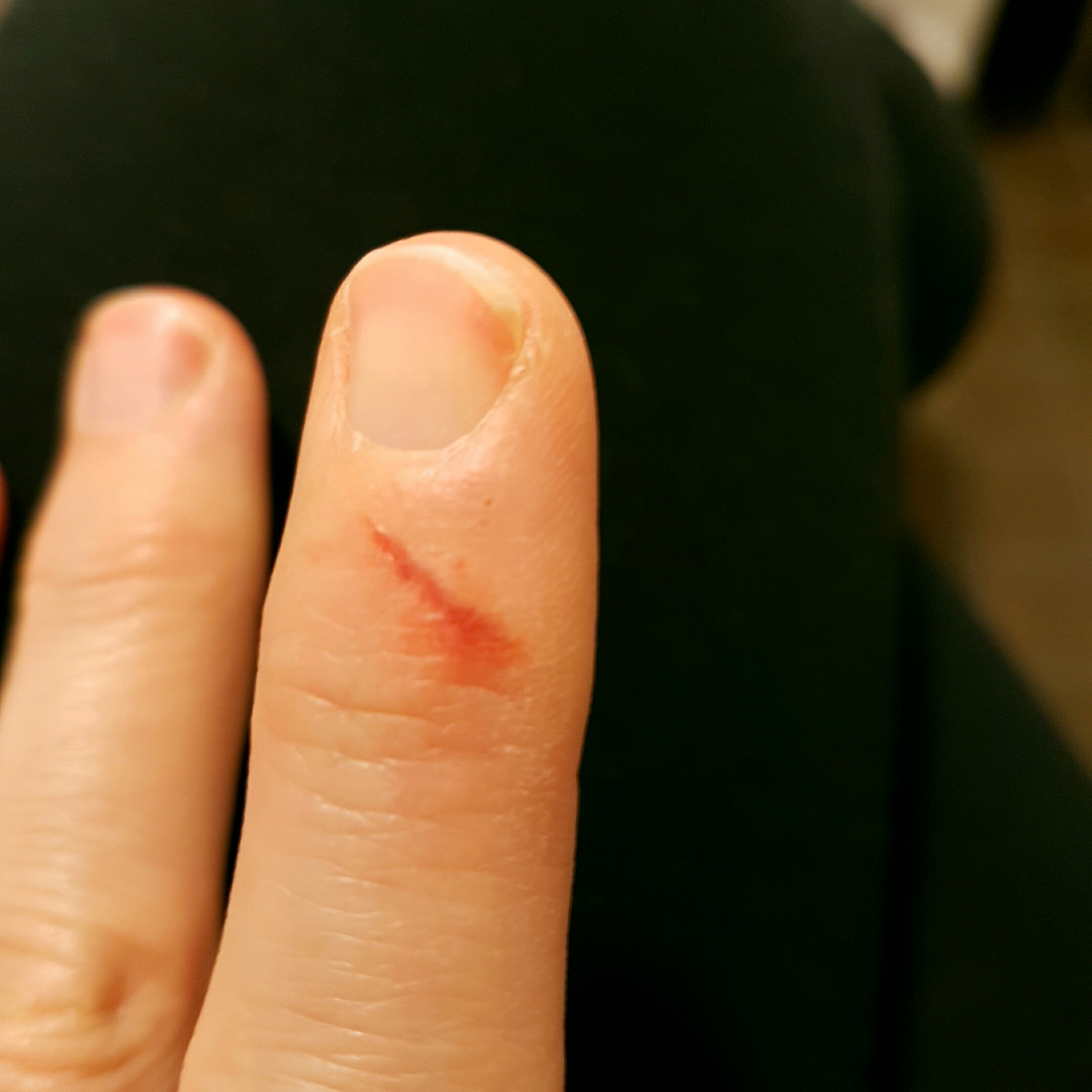
When a dental professional cuts a finger, it’s not plain sailing.

Oh how I hate my profession every time I cut my finger! This time I was slicing a crusty bread and the crust was slightly too hard for the knife. As a result the knife slipped into my index finger, rather deep. But I made a compression bandage and the cut is pretty neat at the moment.

The big question for all the dental professionals is, should one do clinical work with cut like this on a hand?