I am reposting one of my blog posts in the light of the news of the 10-year-old Briony who died from herpex simplex virus which the doctors failed to diagnose.
In this blog post I wrote about a dental nurse who contracted the herpes simplex virus whilst the dentist was treating a patient with a cold sore. I wrote that the GP diagnosed a primary herpes (meaning she had never had herpes infection which most people do have as a child). What I did not share with you was the fact that the dental nurse attended the GP’s practice on Friday and the GP sent her home thinking she had gingivitis. The nurse tried to tell the GP that she had seen a periodontist in her practice due to the ulceration in her mouth and it definitely wasn’t gingivitis. Nevertheless the GP advised the use of chlorhexidine mouthwash and sent her home.
Over the weekend she developed high fever (40 degrees) and could not eat anything due to sore mouth. At this point the ulceration was covering every corner of her mouth including the lips. She returned the GP’s practice on Monday morning and was barely able to stand up. Still the GP insisted it was gingivitis. But at that point the nurse realised the GP needed to see more than what he could with her just opening the mouth and him poking with this wooden spatula. So she grinned as wide as she could. The GP jumped back and said “Well that is definitely a herpes infection!” and prescribed the antiviral medication.
In case you haven’t read the news about Briony, click here.
My heart goes out to Briony’s family who must be devastated. RIP little Briony.
A patient came in for a long appointment to have a bridge done. This appointment was to include filing down the teeth to abutments which meant that the high-speed drill was to be used. A lot. High …
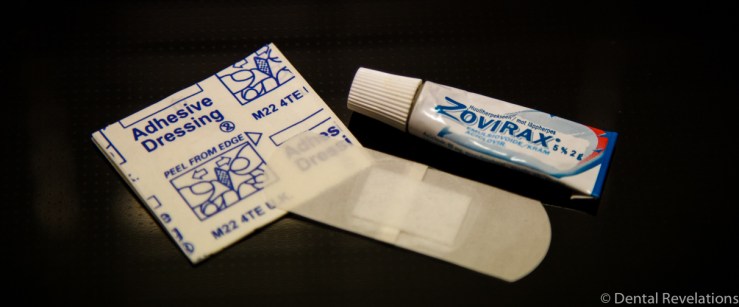
Zovirax can be used to make the cold sore heal quicker.
A patient came in for a long appointment to have a bridge done. This appointment was to include filing down the teeth to abutments which meant that the high speed drill was to be used. A lot.
High speed drills have water cooling system and this means there are aerosols in the air when the drill is used. And the aerosols carry pathogens from the patients mouth as far as two metres (about 6,6 feet) from it’s origin.
The nurse noticed that the patient had a large cold sore on a lip. Dentist appeared as if he had not noticed it and asked the patient to sit down in the patient chair. Chair was tilted back and when the dentist put his fingers inside the patient’s mouth the nurse discreetly pointed out the cold sore. The dentist carried on with the treatment and ignored the cold sore.
The nurse was worried. Very worried. And she had all the right to be. She knew the cold sore virus – herpes simplex – can easily spread to her eyes and hands, dentist’s eyes and hands, patient’s eyes and mouth via the aerosols produced by the high speed drill.
Herpes simplex virus in the eye can result in blindness.
Herpes infection on hands (herpetic whitlow) of a dentist/hygienist/nurse might force a career change as one cannot do any treatment on patients when the herpetic whitlow is active.
But the nurse didn’t have any other option but to continue with the treatment as the dentist is considered to be the one who is more educated in the matters of health and carries the responsibility of the treatment. This means the dentist makes the decisions behalf of the nurse and the patient whether to continue with the treatment or not.
Now it might be a good idea to read one of my previous post about integrity of dentists so you understand the motives behind the dentist’s decision in this story.
So on they went with the high speed drill. For an hour and a half.
Less than a week later the nurse developed a bad head ache and the next day she had sores in her mouth. Two days later she had temperature of 40 degrees and the mouth, gums and lips were full of painful sores. The GP diagnosed a primary herpes and prescribed anti-viral medicine. She was off work for a week.
When the patient with the cold sore was seen the next time in the surgery he had small blisters near the operated site.
Before the anti-viral medication was developed the primary herpes used to be an infection that was often lethal. The doctors treating the patients with primary herpes could only cross their fingers and hope the patient will make through it. Many didn’t.
It can still be lethal but we have medication to treat it.
Most of the people get the primary herpes as a child and it often is asymptomatic. If contracted as an adult the primary herpes can have more difficult symptoms.
The primary herpes can be followed by secondary herpes (recurrent infection) – most commonly as a cold sore on a lip. The most frightening one of the recurrent infection of herpes simplex virus is encephalitis.
Guidelines for Treating Patient’s with Cold Sore
I asked my friend Google and she quickly found me several sites that were unanimous about what us dental professionals should do if we see a patient with a cold sore.
Do not do any treatment that can be postponed!
To convince you I copy-pasted guidelines from couple of sites.
Elective dental treatment should be deferred for patients with active lesions as aerosolization of the virus may occur during dental procedures, placing both the patient and oral health care provider at risk for possible infection or re-infection.
Elective treatment should be postponed until the lesion has healed completely. Though the patient may be comfortable after you have applied a topical medication, there is still the risk of spreading the disease to the health-care provider.
Because herpes is transmittable to patients from dental health-care professionals who have active lesions, there is a risk of spreading this disease. The guidelines from the CDC are clear. Each of us has to keep patient safety and staff safety a priority.
Conclusion
The guidelines are clear. The medical facts are clear. Why do dentists still treat patients with cold sores and risk the health of the nurse and the patient, let alone their own health? They if anyone should know how serious risk it is.
So why?
I’m afraid you might know what’s coming (especially if you read my post Morals in Dentistry). Yes, the only reason for this kind of selfish and negligent behaviour from a dentist is GREED. And perhaps small amount of twisted enjoyment of having power – being almighty in this little world that has two people the dentist can make decisions for.
When the patient walks in the surgery with a cold sore it is simply just not acceptable from the dentist’s perspective to reschedule the appointment even though everyone’s health is at risk. No, no. Profit overrides reason. Shame you who just recognised yourself.
I know there are also hygienists who see the patients with a cold sore. But this is because they don’t either know better or because they are not practice owners. Refusing to see a patient with a cold sore is not considered to be in the best interest of the practice. Plus what can you do if the patient with a cold sore just saw a dentist for a filling and is scheduled to see you for a scaling. How can you say no when the dentist said yes?
It requires lot of self confidence and experience to be able to stand up for you right to decide for your own health. Something the nurses do not have a chance to do. It proves once again how the dentist-nurse relationship is nowhere near about equality as co-workers. Not even in the matters of personal health.
I reschedule the appointment if the patient has a cold sore. And the next appointment won’t be sooner than a fortnight. I also use the opportunity to inform patient about the herpes simplex and ask patient to cancel the appointment next time when he gets a cold sore before the dental appointment.
And seriously (for all the dental professionals):
Applying Zovirax and placing a plaster on top of the cold sore before doing the treatment is just simply bonkers.
Here’s some further reading about the guidelines of seeing a patient with a cold sore.
Remember to share this post if you think there was important information that everyone should know.
I used to work with a very talented oral and maxillofacial surgeon who did not accept just any nurse to be his assistant. The reason for this was that he wanted absolute aseptic environment for the implant surgeries he was performing. In his words
“One either has an aseptic consciousness or doesn’t. It cannot be taught.”
At that time I thought he was exaggerating but I have learned since that he was actually right.
Simplified, the aseptic conscious is an ability to know when surface, instrument, hand is contaminated by bacteria and how and in which order you start to fix it to make it asepsis. It is an ability to know where you can touch without contaminating the gloves when you are treating a patient. It is the key for effective cross infection control in dental practices.
We learn asepsis at dental schools. But there are things you cannot learn by just reading from the book. Sometimes even practice won’t teach us. In my experience aseptic conscious is as hard to learn as singing. If you do not have the gift you will not become a successful singer (the one’s singing in the shower do not count in this comparison!).
Failing in Basics
A dentist puts her face mask on, washes her hands and puts the gloves on. She gets closer to the patient, adjusts her face mask and uses her little finger to move her hanging fringe to the side of her head…
Err, what went wrong? Pretty much everything after putting the gloves on.
Not understanding what contaminates the clean areas/instruments/hands is a major problem in dentistry. It applies to all the dental professionals – not only the dentists. Even bigger problem is that it is also a subject amongst dental professionals that is hard to bring up if you see a colleague doing something that compromises the cross infection control.
But we must speak about it! How else would they learn asepsis?
Clean Hands
Washing hands needs to be done correctly for it to be effective. But washing hands can be replaced by the use of disinfection gel if the hands are not visibly contaminated. But this needs a correct technique too.
All the professional’s should watch this video about washing hands and using the disinfection gel. I bet many of us fail in the technique.
I must point out that in this video they apply far to little of disinfection gel – if you have an automatic dispenser like the ones the hospitals have, trust the amount the dispenser gives you even if it feels too much.
Also in this video they begin the use of disinfection gel in wrong order. The correct technique goes like this:
Take the gel to the palm of your left hand (or the right, it doesn’t matter from which hand you start)
Dip the finger tips of your right hand in the gel on your balm
Pour the gel to the palm of the right hand
Dip the left hand’s finger tips in the gel
Only then start to spread the gel as advised in the video
Important to remember: Never try to speed up the evaporation of the disinfection gel by waving your hands in the air. This will only contaminate your hands with airborne pathogens.
Revelations
Too many of us professionals fail in either disinfecting the hands or keeping them uncontaminated during the treatments. To prove my point I will tell you my observations.
I have seen
dentist removing temporarily his face mask during the treatment to speak to the patient and placing it back again (the same mask and the same gloves) before continuing the treatment
dentist using the mirror handle’s tip to press computer keyboard key’s in the middle of the treatment
dentist touching the water tap (especially when adjusting dentures/bite block to rinse the apparatus) with the gloves he’s entering patient’s mouth
dentists, hygienists and nurses to reach instruments/materials inside the surgery cupboard with gloves that are contaminated by patient’s saliva
dentists removing their glove from one hand in the middle of the treatment to do something “aseptically” and then placing the same glove back again
dentists removing both of their gloves in the middle of the treatment to do something “aseptically” and then placing the same gloves back again
dentists using disinfection gel for the gloves
nurses having long and polished nails – I mean reeeally long
dentists, hygienists, nurses wearing watches and bracelets
Thank god dental surgeries are pretty much paperless nowadays. The dentists used to check the dental records in the middle of the treatment with the same gloves as they were treating the patient.
Conclusion
A Dentist, hygienist or nurse with pathogen-free hands is every patient’s right to have.
So do pay attention how you get ready for the treatment with each patient. Sometimes we are behind schedule and we cut corners but with this matter you simply cannot.
I will end this post by an information on how all the dental professionals should get ready for the patient (in every day dentistry) and hope you will follow this advise already today.
Before the treatment:
disinfection gel (or hand wash if visibly contaminated hands)



 Dental Revelations