
RDA Value in Toothpastes – Any Relevance?

20180223_123729
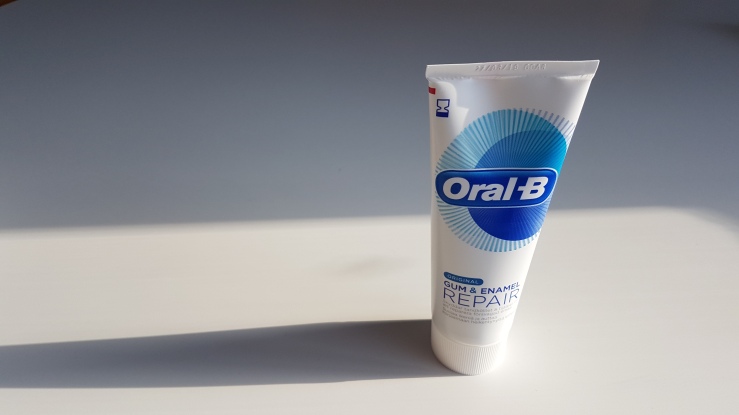
Gum & Enamel Repair Original Toothpaste

I promised in my post Oral-B Gum & Enamel Repair Original Toothpaste Review that if I find out the RDA level of this toothpaste I will announce it. Well I found it out recently, sort of. And this occurrence sort of made me annoyed once again. So I’m going to pour it out now.

I saw a representative from Oral-b recently. She was going to ask about our experiences of the Gum & Enamel Repair Original Toothpaste. I told mine and to my pleasant surprise she suggested we would fill an adverse reaction report. So we did. She said she had never heard anyone’s tongue getting numb from their toothpaste.

My most important question to ask from the rep was the magic RDA value of this toothpaste. I was dreading it as the reps are quite sensitive about the whole subject of RDA value. They know that it is thought widely amongst the dental professionals that the higher the RDA value is the more abrasive it the toothpaste is. So the manufacturers want to keep it a secret.

What Is RDA?

To explain it very simple way, the RDA is the grittiness of the toothpaste. If it is too high, it can cause tooth wear. But to explain RDA more elegantly, here is a quote by ADA (American Dental Association):

To help quantify the abrasivity of dentifrices, the ADA along with various academic, industry and government agencies established a standardized scale called Relative Dentin Abrasivity (RDA). This scale assigns dentifrices an abrasivity value, relative to a standard reference abrasive that is arbitrarily given an RDA value of 100.

All dentifrices at or below 2.5 times the reference value, or 250 RDA, are considered safe and effective. In fact, clinical evidence supports that lifetime use of proper brushing technique with a toothbrush and toothpaste at an RDA of 250 or less produces limited wear to dentin and virtually no wear to enamel.

ADA (American Dental Association)

So what this quote is saying is that most of the toothpastes are safe. Mind you, FDA (U.S. Food & Drug Administration) has set the safe limit of RDA to 200. But internationally it is the RDA 250 or below that is recognised as safe to use. I did a research and found out that many dental sites (both english and my native language) state that the highest safe RDA level has been set too high. It should be 100 or less.

Here is a link to one of the dental sites with a very good chart about abrasiveness levels in different toothpastes.

The Big Question

Ok, back to seeing the rep. I gathered all my courage and asked the big question.

Err, what is the RDA level of this toothpaste?

Oh boy, he looks annoyed. He asks if he has ever shown us a video about RDA. No, he hasn’t. He took his tablet out and put the video rolling. It was about RDA level of the toothpaste made by Oral-b. In the video they were demonstrating that it doesn’t matter what the RDA level is as long as it is below 250.

He looked victorious when the video ended. I asked again.

So, what is the RDA level of this toothpaste?

He said with a sigh that the RDA level of the Gum & Enamel Repair Original Toothpaste is somewhere between 100-200.  So this is what I meant when I found out the RDA level of this toothpaste, sort of.

Conclusion

It is good to remember that not only the toothpaste’s RDA level determines how much you will get tooth wear. If you brush your teeth straight after breakfast, with a hard toothbrush and with too vigorous technique (applying too much pressure), it has very little meaning what the RDA level of the toothpaste is.

You might be interested in these posts as well:

Testing Oral-b Smart Phone Holder, Take 1
Testing Oral-b Smart Phone Holder, Take 2
Oral-B Gum & Enamel Repair Original Toothpaste Review
Google for a Day – Comprehensive Answers about Cold Sore and Dentist

Dental Revelations Blog-11
To treat or not to treat? The answer should be easy one to answer. Why isn’t it?

My most popular post by far has been Cold Sore Is Herpes – Cancel Your Dental Appointment Because Your Dentist Won’t!. It proves that people certainly know that herpes simplex virus is not something that you could compare to common cold for example. They are unsure what to do when you have a cold sore and you have booked a dental appointment. And like with many other matters that you are not sure about, people turn to their all-knowing friend Google.

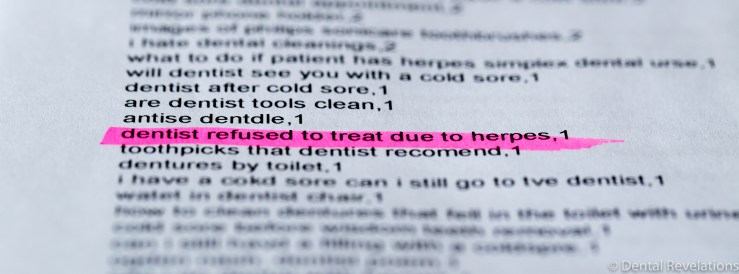
But it’s not only the patients who are unsure. Also the dental professionals seem to be confused and represent their questions to Google. How do I know this? Well, WordPress has very useful statistics that include also the search terms people have used when they end up to my blog. I have kept an eye on the search terms and I got this idea to write a post about them and act as a search engine for you. So here it is. The search terms (ST) and my answers.

ST: Can you go to the dentist with a cold sore?

Preferably not. Any treatment that can be postponed should be postponed.

ST: Can they take out a wisdom tooth with a cold sore?

Only the ones that cannot be postponed. If the wisdom tooth is risking your life due to an acute infection and signs of the infection are spreading to your bloodstream then it should be removed even if you have a cold sore.

ST: Why won’t the dentist see me when I have a blister in my mouth?

Because your dentist knows his business. Any responsible dentist would postpone the treatment if there are signs of herpes infection inside your mouth, lips or nose. But your dentist could explain a bit more why he didn’t see you so you wouldn’t have to google it. Here’s further reading about cold sore as an occupational hazard.

ST: Can dental treatment cause cold sores?

In theory, yes. If the practice’s cross infection control protocol is not up to the standards and they treat people with cold sores, the virus can be passed on to the next patient. The virus can stay infectious as long as 2 hours in the surfaces of the surgery and the instruments. If the next patient has never had any type of herpes infection, she’ll get primary herpes first. That’s nasty thing to have if you are an adult. Cold sore can follow as a secondary herpes after a while.

ST: Cold sore, herpes simplex, dental appointment.

I hope these things never meet in real world. Unless absolutely necessary.

ST: Does an orthodontist still take you if you have a cold sore?

If the treatment can be postponed, it should be postponed. But having said that, if the orthodontist treatment is such that no rotating, high-speed drills are to be used then it might be ok to do the treatment if the cross infection control is up to the standards.

ST: Can I have dentist with a cold sore?

Are you sure you want one? Wait until it clears and you’ll find that he is exactly the same person without cold sore. Just less infectious.

ST: Can I have a dental treatment with a cold saw?

Well, you actually could. We have instruments that look like a saw.

ST: Can you get oral herpes from the dentist.

Yes if your dentist’s cross infection control is not up to the standards and they treat patient’s with cold sore. Herpes virus can survive 2 hours in the surfaces that have not been adequately disinfected.

ST: How dental professionals can prevent from getting herpes?

Do not treat patients with cold sore. If you must (patient’s life is at risk), protect yourself with visor mask, take care of your skin as healthy skin on hands works as barrier to pathogens, use gloves, try to avoid using high-speed instruments and sonic scaler as they produce aerosols that carry pathogens, do only what is necessary until the time when the cold sore has healed. There’s no point in covering the cold sore with plaster or similar as the herpes simplex virus is also in the saliva. You should also read this article.

ST: Should a dental hygienist treat a patient with a cold sore?

Treatments the hygienists perform are rarely such that cannot be postponed. So do not take a risk. If you still act against my advise, protect yourself as advised above and do not use sonic scaler. And cross your fingers. You should also read this (scroll down to Case histories).

ST: Dentist refused to treat due to herpes.

Hooray! We have hope! Hold on to your dentist, he clearly knows his business!

ST: Dentist won’t treat me bc herpes.

Another good and responsible dentist somewhere out there! Be happy!

ST: Can I still have a filling with a cold sore?

No dentist should make you a filling when you have a cold sore. Making a filling requires high-speed rotating instruments that have water cooling system. They produce aerosol when used and the aerosols carry pathogens far and wide – possibly in the eyes of the dentist, nurse and yourself! Even if you wear protective eye-ware.

ST: What to do if patient has herpes simplex dental nurse.

I’m afraid there is not much you can do as the dentist is considered to be the one who is responsible for the treatment. The dentist decides if the treatment can be carried out. He shouldn’t of course treat patients with cold sore unless patient’s life is at risk but as you probably know the reality is very different. When you begin working with a new dentist, ask him how he deals with patients who have cold sore. If he is all about money, money, money, change jobs. Protect your health and your future as dental nurse. You can always show the dentist my article about cold sore or this article. Maybe that’ll convince him.

ST: Do dentist still remove teeth if you have a coleslaw.

We do find many things from people’s mouths. Sometimes even coleslaw between the teeth. I don’t think the dentist minds. He just wants to get your tooth out.

(It’s an obvious spelling mistake or an auto-correct error but I couldn’t resist making fun of it.)